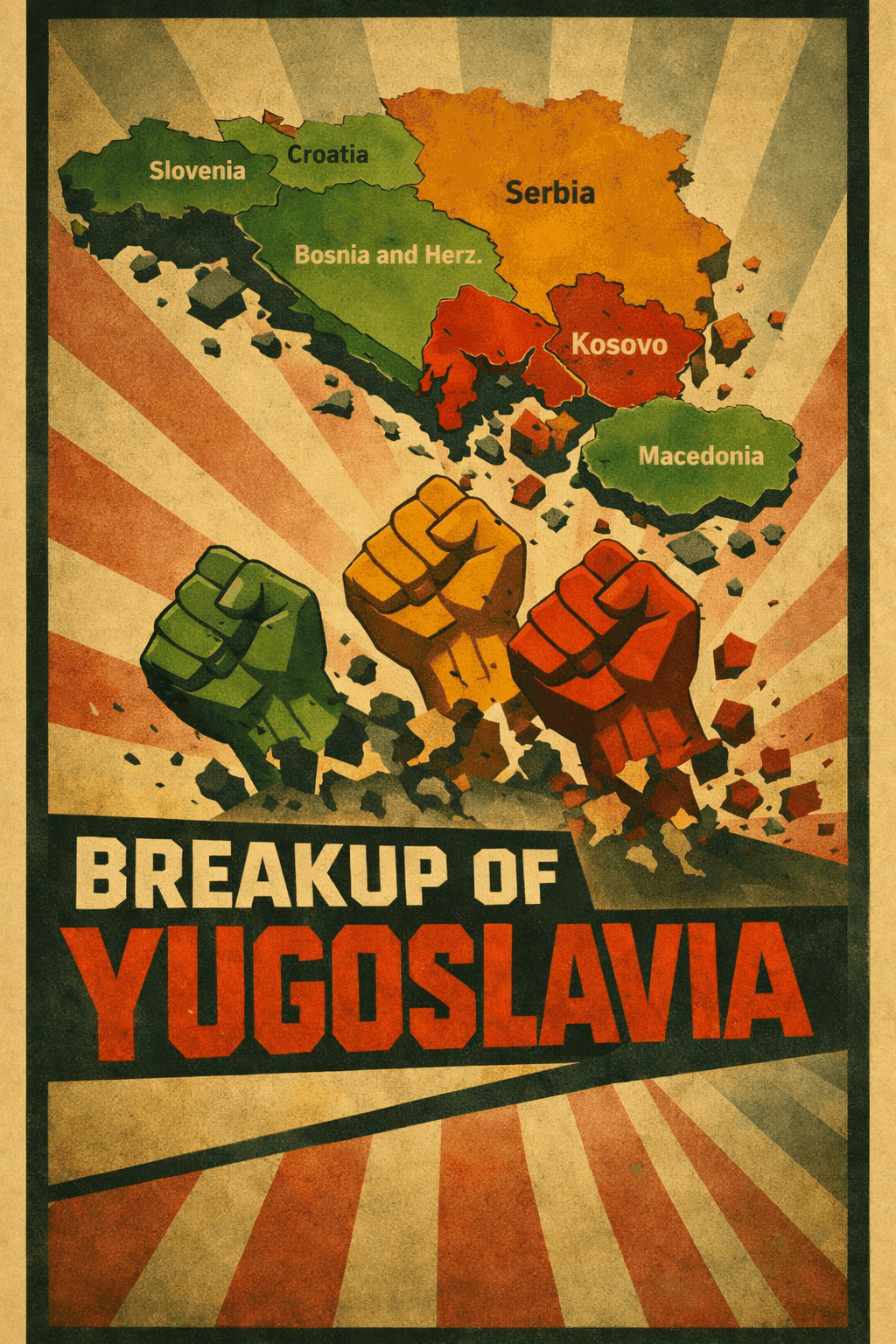
The Breakup of Yugoslavia
From the collapse of the Communist party congress in January 1990 to Kosovo's declaration of independence in February 2008, these maps trace how one country became seven. Slovenia and Croatia left first, on the same day in June 1991; the wars that followed killed some 130,000 to 140,000 people and displaced around 4.4 million. The last border was not drawn until more than seventeen years after the first.
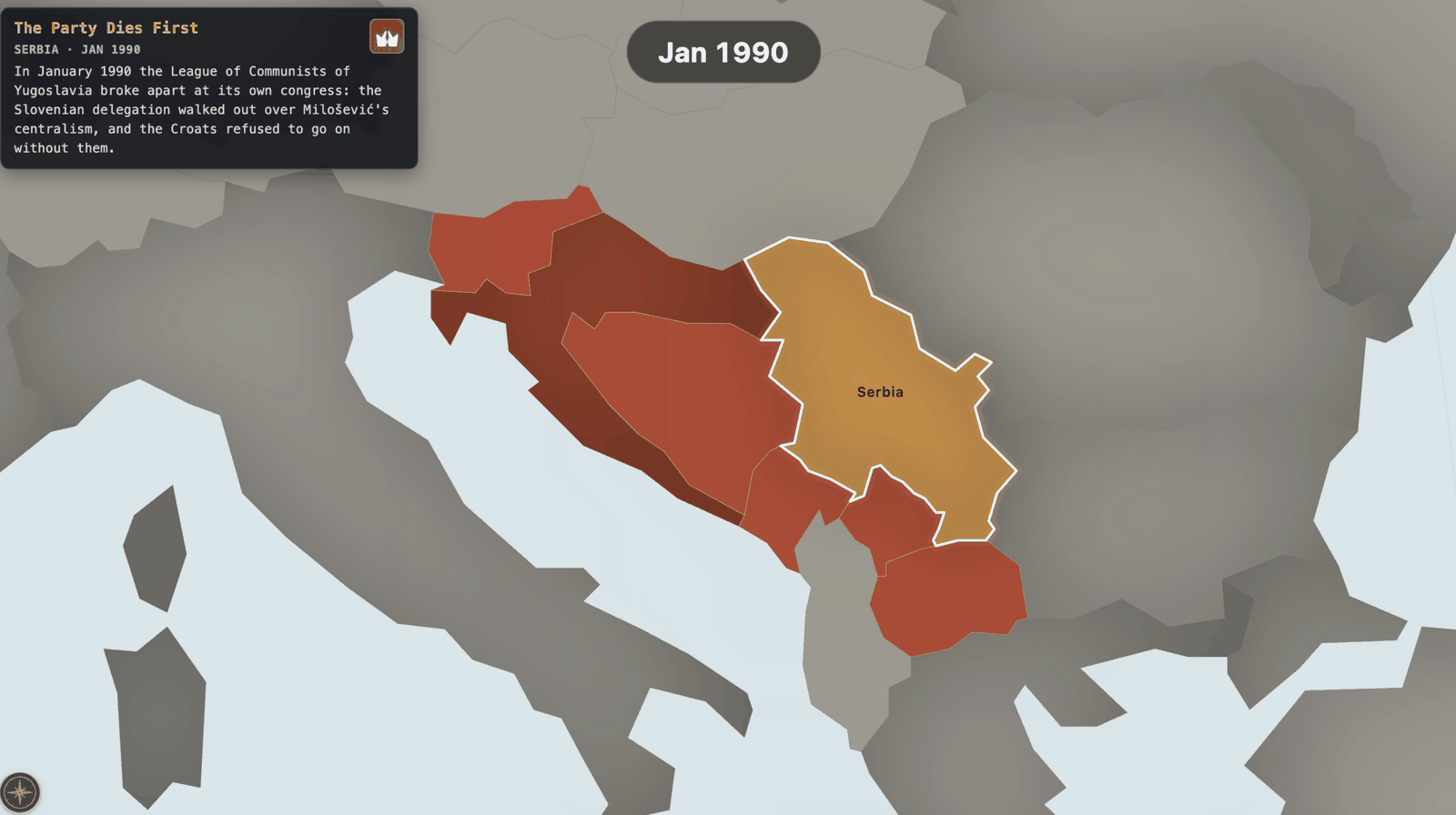
The Party Dies First
On 20–23 January 1990, the 14th Extraordinary Congress of the League of Communists of Yugoslavia collapsed. The Slovenian delegation, demanding a looser confederation, was outvoted on every proposal by Slobodan Milošević's bloc; on 22 January the Slovenians walked out, and the Croatian delegation refused to continue without them. The congress adjourned and reconvened months later without Slovenia, Croatia or Macedonia; the party that had held Yugoslavia together since Tito soon ceased to exist. Within months, every republic held multi-party elections — and nationalists won nearly everywhere.

Croatia Declares Independence
Jun 25, 1991 — Slovenia Declares Independence: Slovenia, the wealthiest and most ethnically homogeneous republic, declared independence on 25 June 1991, honoring a December 1990 referendum in which 88.5% of the total electorate voted to leave. The federal government in Belgrade declared the move illegal and ordered the Yugoslav People's Army (JNA) to secure the republic's borders — triggering war within two days.
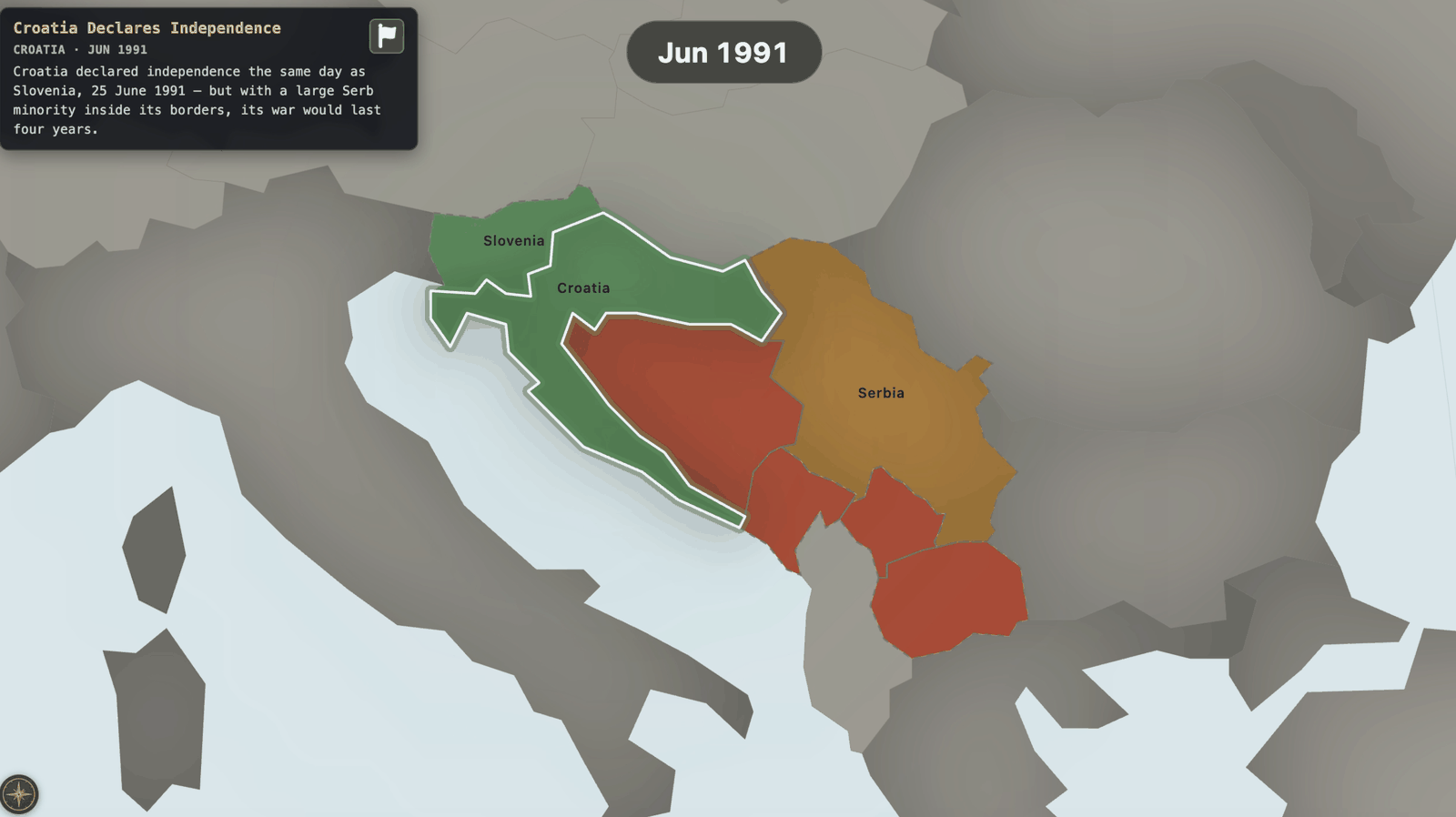
Jun 25, 1991 — Croatia Declares Independence: Croatia declared independence on 25 June 1991, the same day as Slovenia, after a referendum on 19 May in which 93% voted in favor on an 84% turnout. Unlike Slovenia, Croatia had a large Serb minority, concentrated in the Krajina region, which had already declared its own autonomy with Belgrade's backing. The JNA and Serb paramilitaries seized roughly a quarter of Croatian territory by the end of 1991; the war would not fully end until 1995.


The Ten-Day War
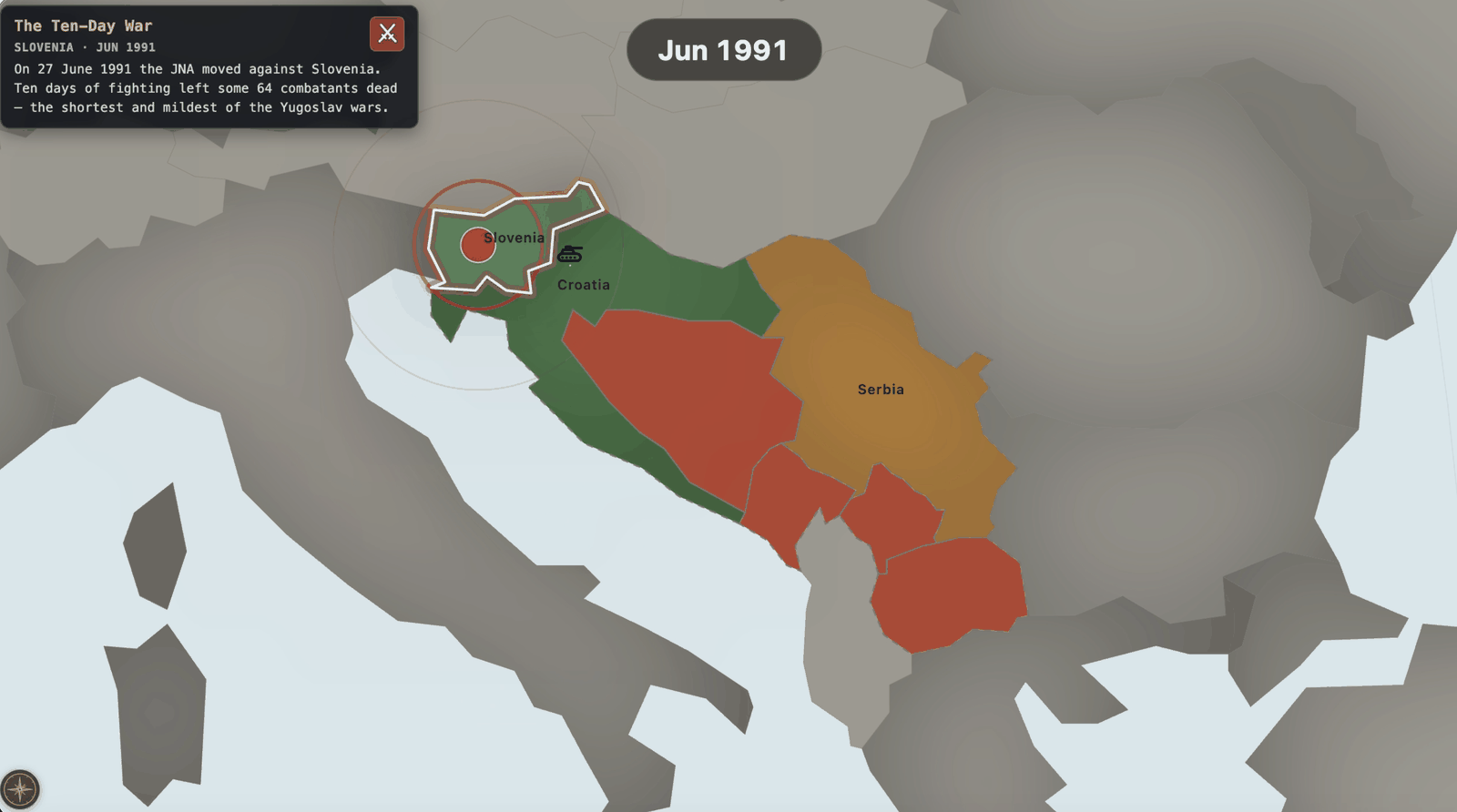
On 27 June 1991, two days after the declaration, the Yugoslav People's Army moved to retake Slovenia's border posts and airport. Slovenian territorial defense forces blockaded JNA columns and besieged their barracks. The war lasted ten days and cost some 64 combatant lives — 45 JNA soldiers and 19 Slovenian defenders. With almost no Serb minority in Slovenia, Belgrade had little to fight for: the JNA withdrew and the war moved south.
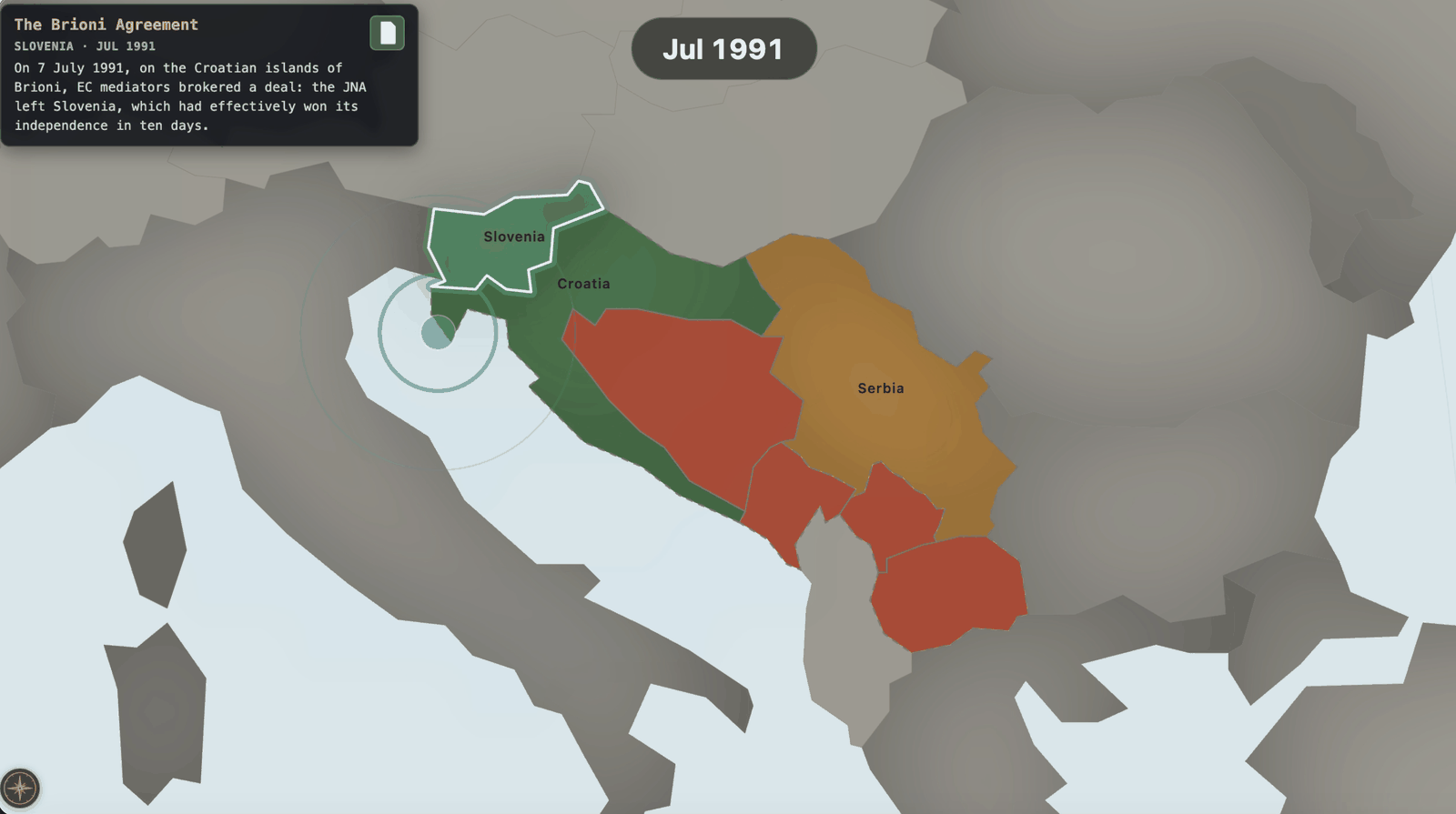
The Brioni Agreement
On 7 July 1991, under European Community mediation on the Brijuni Islands off the Croatian coast of Istria, the parties agreed to a ceasefire: Slovenia and Croatia suspended their independence declarations for a three-month moratorium, and the JNA pulled back. In practice the agreement sealed Slovenia's exit — the JNA completed its withdrawal from the republic by the end of October 1991. The federation's dissolution was now irreversible.
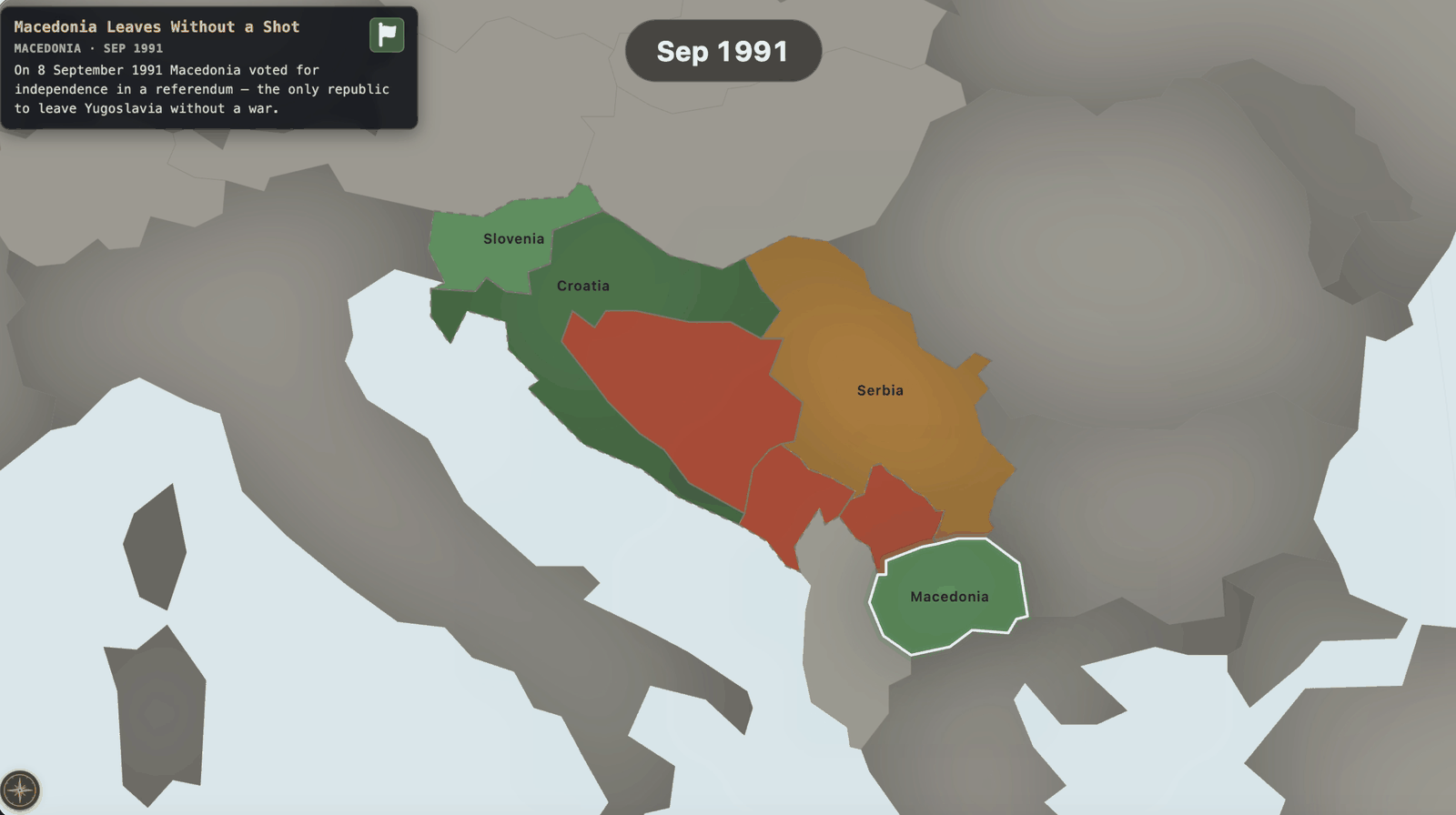
Macedonia Leaves Without a Shot
On 8 September 1991, Macedonia held its independence referendum: over 96% of votes cast were in favor, on a 76% turnout, and independence was proclaimed soon after. The JNA later withdrew peacefully, making Macedonia the only republic to exit Yugoslavia without war on its soil. Its early years were strained instead by a Greek dispute over its name — not settled until the Prespa Agreement of 2018 renamed it North Macedonia.

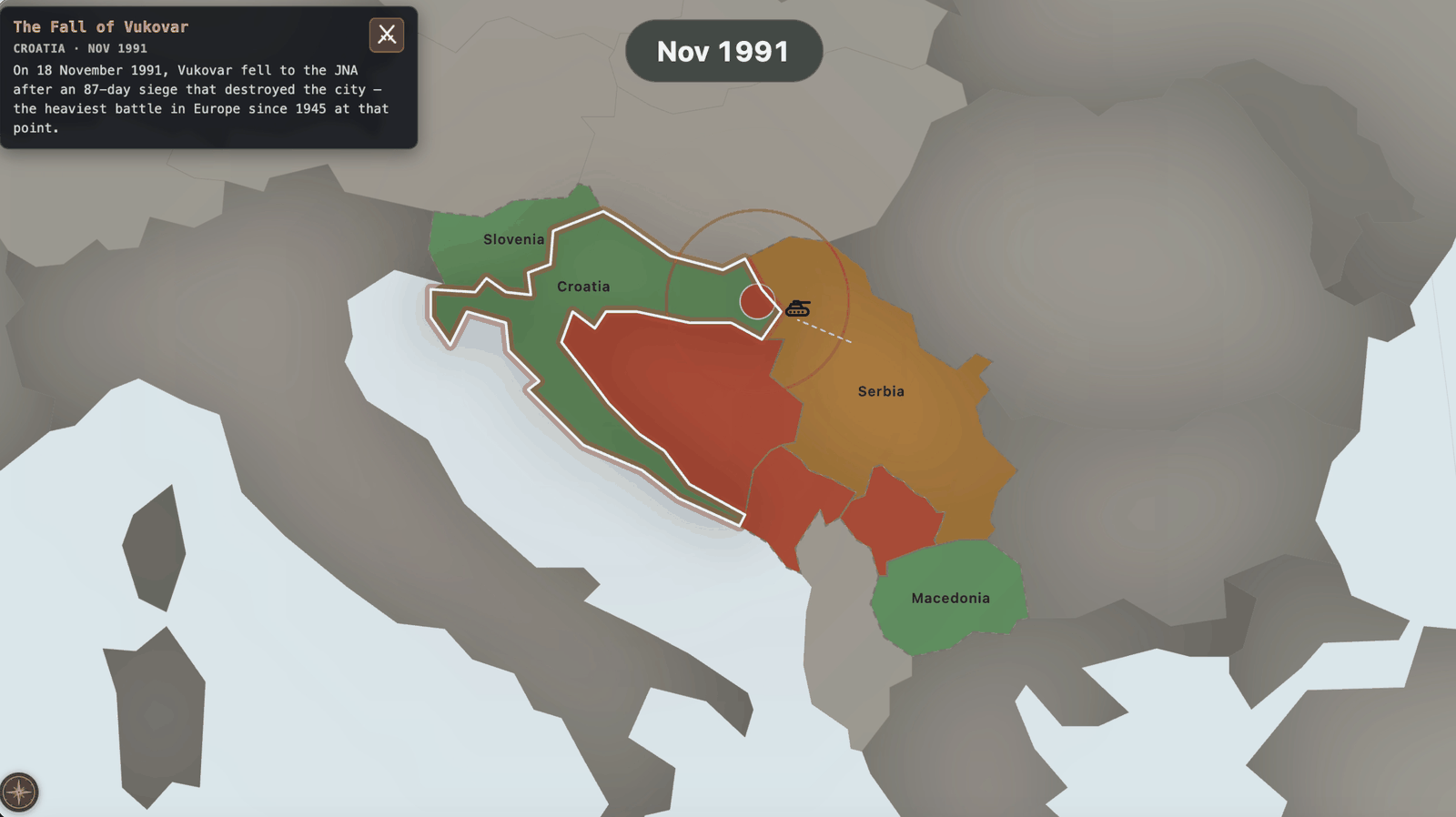
The Fall of Vukovar
After an 87-day siege, the Danube city of Vukovar fell to the JNA and Serb paramilitaries on 18 November 1991. Around 3,000 people died in the battle, and Vukovar became the first major European town entirely destroyed since World War II, shelled at rates of up to 12,000 rounds a day. In the days after the fall, several hundred prisoners — many taken from Vukovar's hospital — were massacred at sites like Ovčara farm, later the subject of ICTY war-crimes convictions, and at least 20,000 inhabitants were expelled. Vukovar became the symbol of the Croatian war.

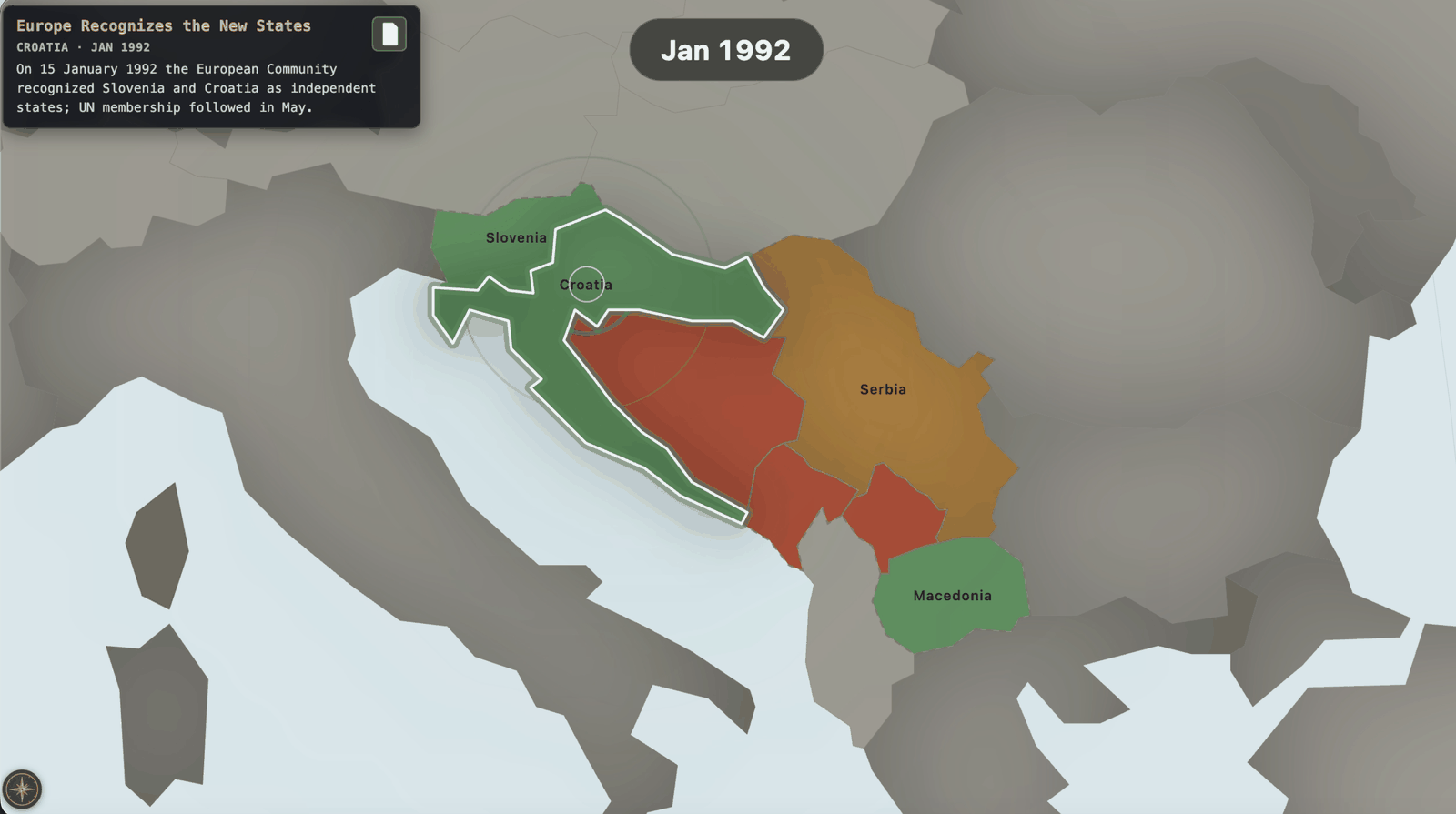
Europe Recognizes the New States
On 15 January 1992, the European Community — pushed hardest by Germany — formally recognized Slovenia and Croatia as independent states. A UN-brokered ceasefire (the Vance Plan) froze the front lines in Croatia, with about a quarter of the country under Serb control, patrolled by UN peacekeepers. Both republics joined the United Nations on 22 May 1992. Yugoslavia as the world had known it no longer existed.
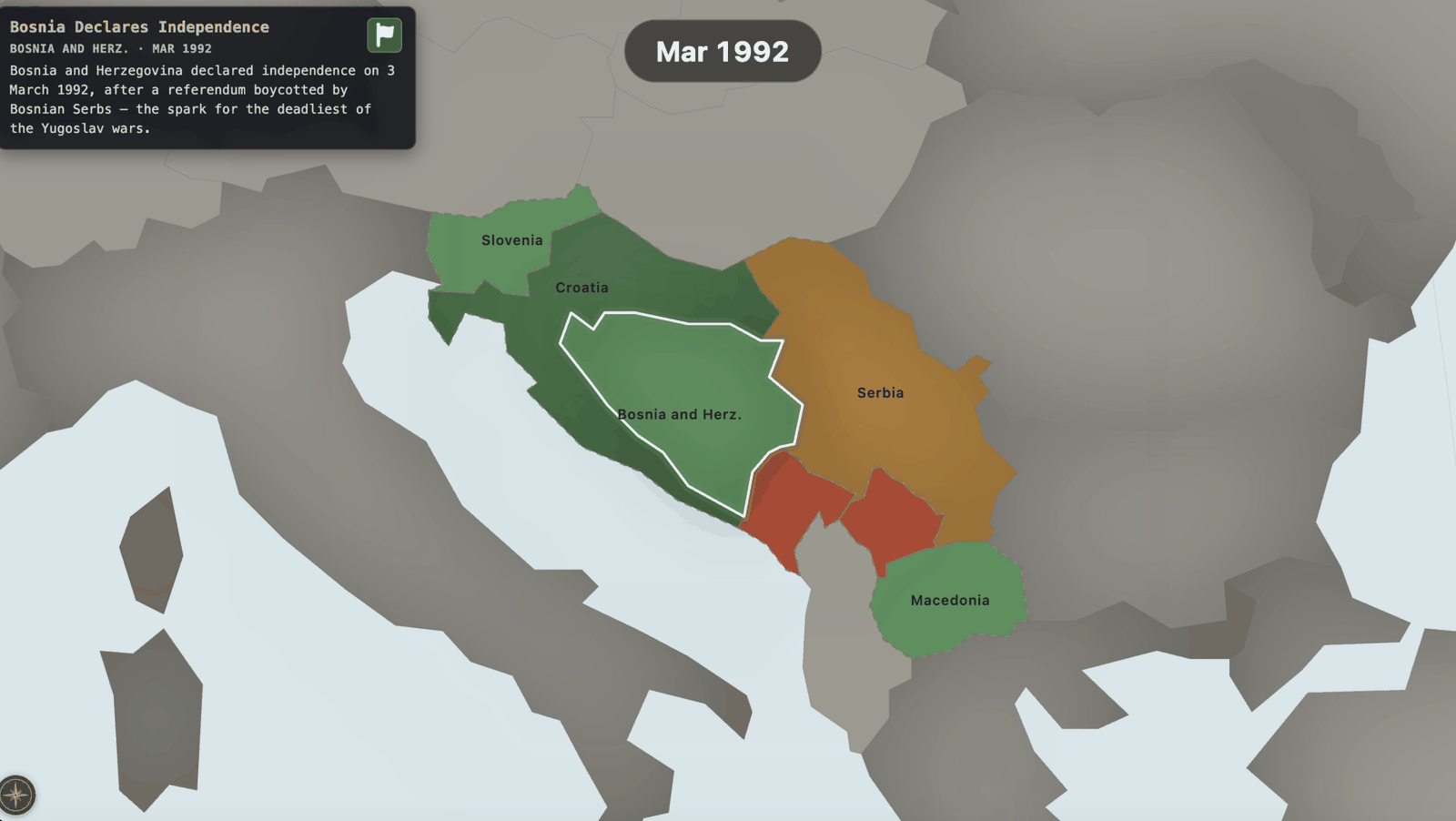
Bosnia Declares Independence
Bosnia and Herzegovina — the most ethnically mixed republic: 44% Bosniak, 31% Serb, 17% Croat — declared independence on 3 March 1992, after a referendum in which 99.7% voted in favor on a 63% turnout; Bosnian Serbs boycotted it almost entirely and proclaimed their own republic. President Alija Izetbegović had warned that Bosnia faced an impossible choice between independence and remaining in a Serb-dominated rump state. War began within a month.
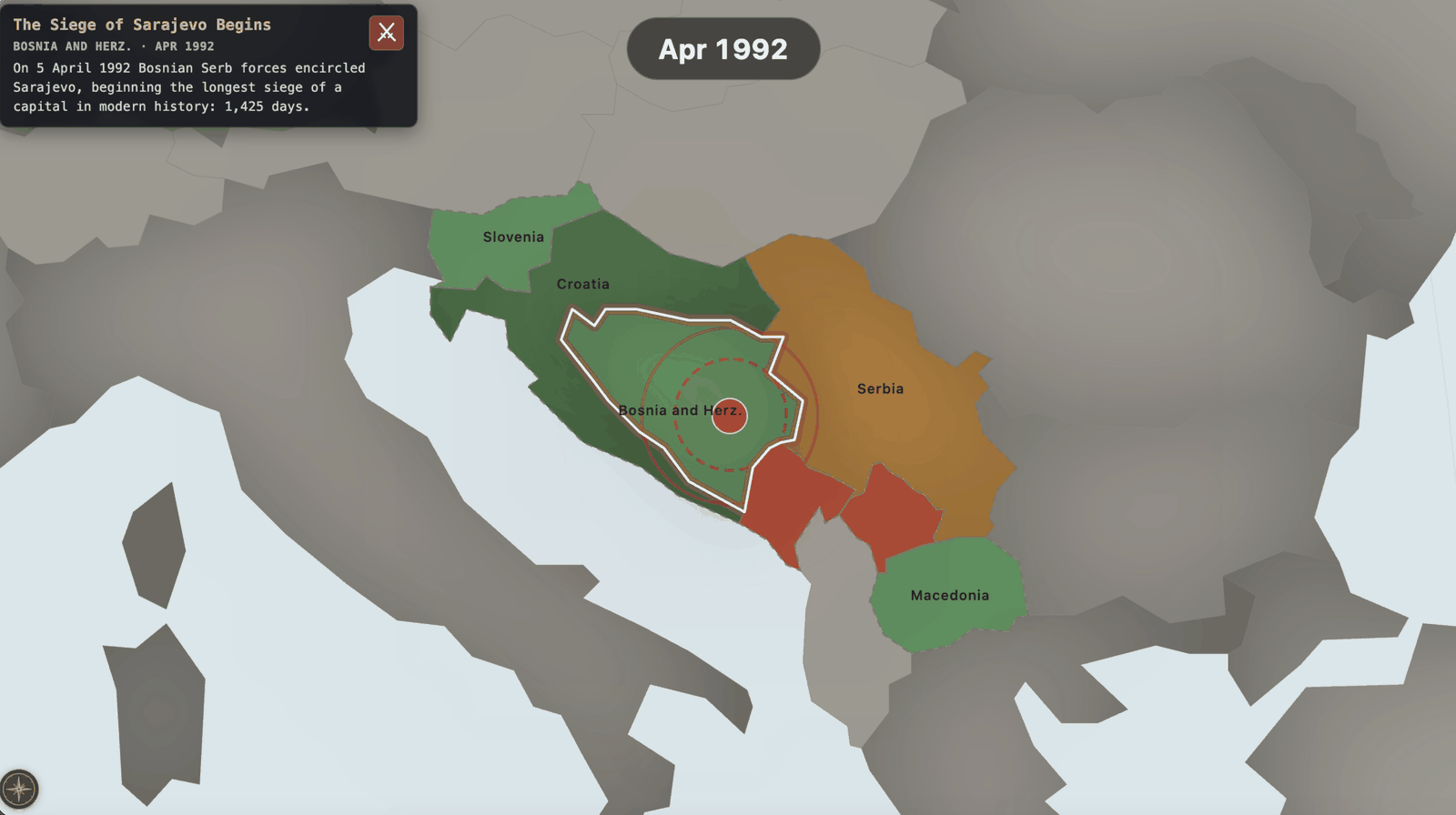
The Siege of Sarajevo Begins
On 5 April 1992, Bosnian Serb forces and the JNA encircled Sarajevo from the surrounding hills, beginning what would become the longest siege of a capital city in modern history — 1,425 days, until 29 February 1996. Nearly 14,000 people died in the city, including over 5,000 civilians, under constant shelling and sniper fire. The same week, the EC and the US recognized Bosnia's independence, and Serb forces began the campaign of ethnic cleansing that defined the war.

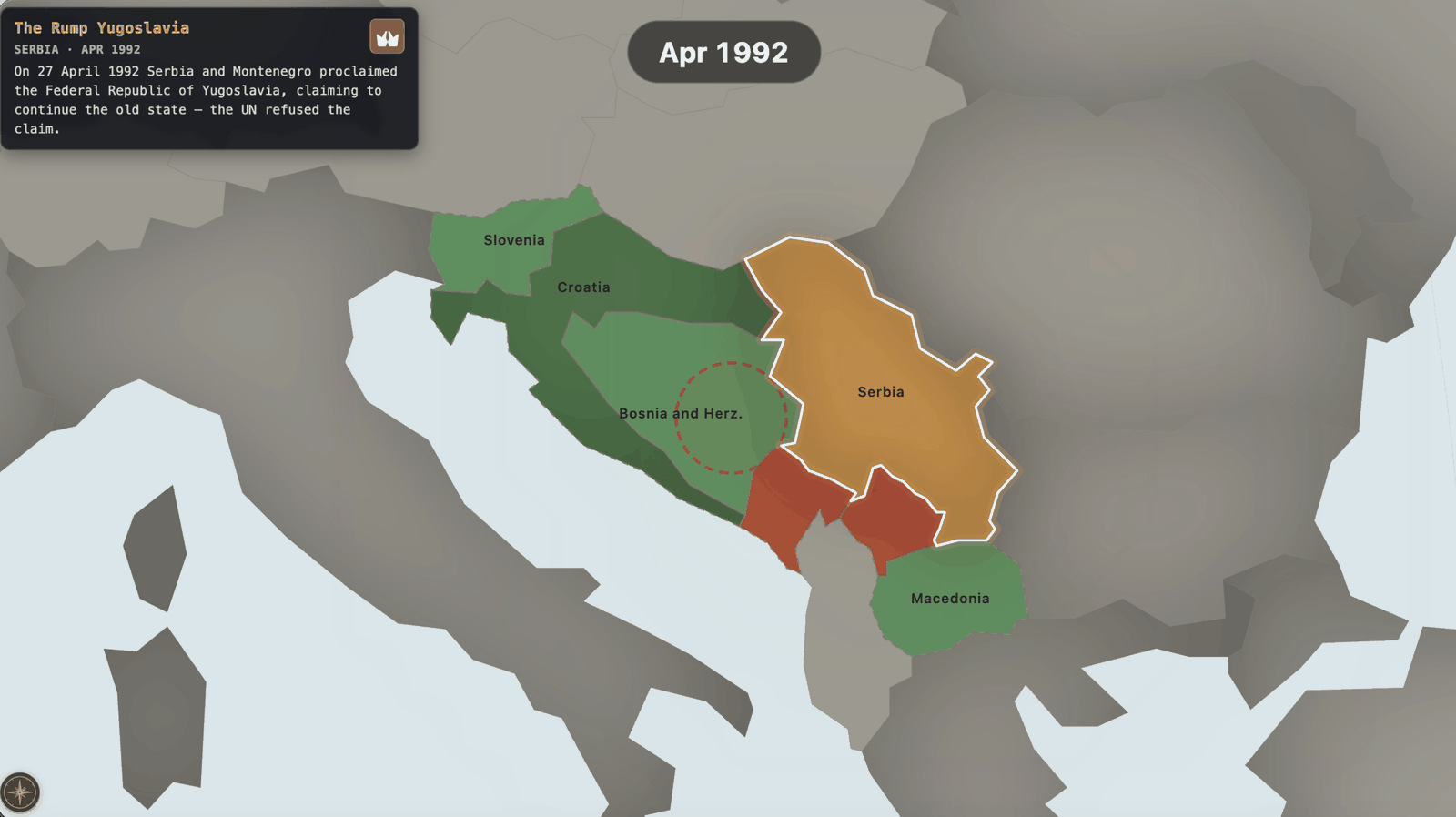
The Rump Yugoslavia
On 27 April 1992, the two remaining republics — Serbia and Montenegro — proclaimed the Federal Republic of Yugoslavia, claiming to be the sole legal continuation of the old federation. The UN rejected the continuity claim and, in May 1992, imposed sweeping sanctions over Belgrade's role in the Bosnian war. The 'third Yugoslavia' spent the decade internationally isolated, its economy wrecked by sanctions and one of the worst hyperinflations ever recorded.


Srebrenica
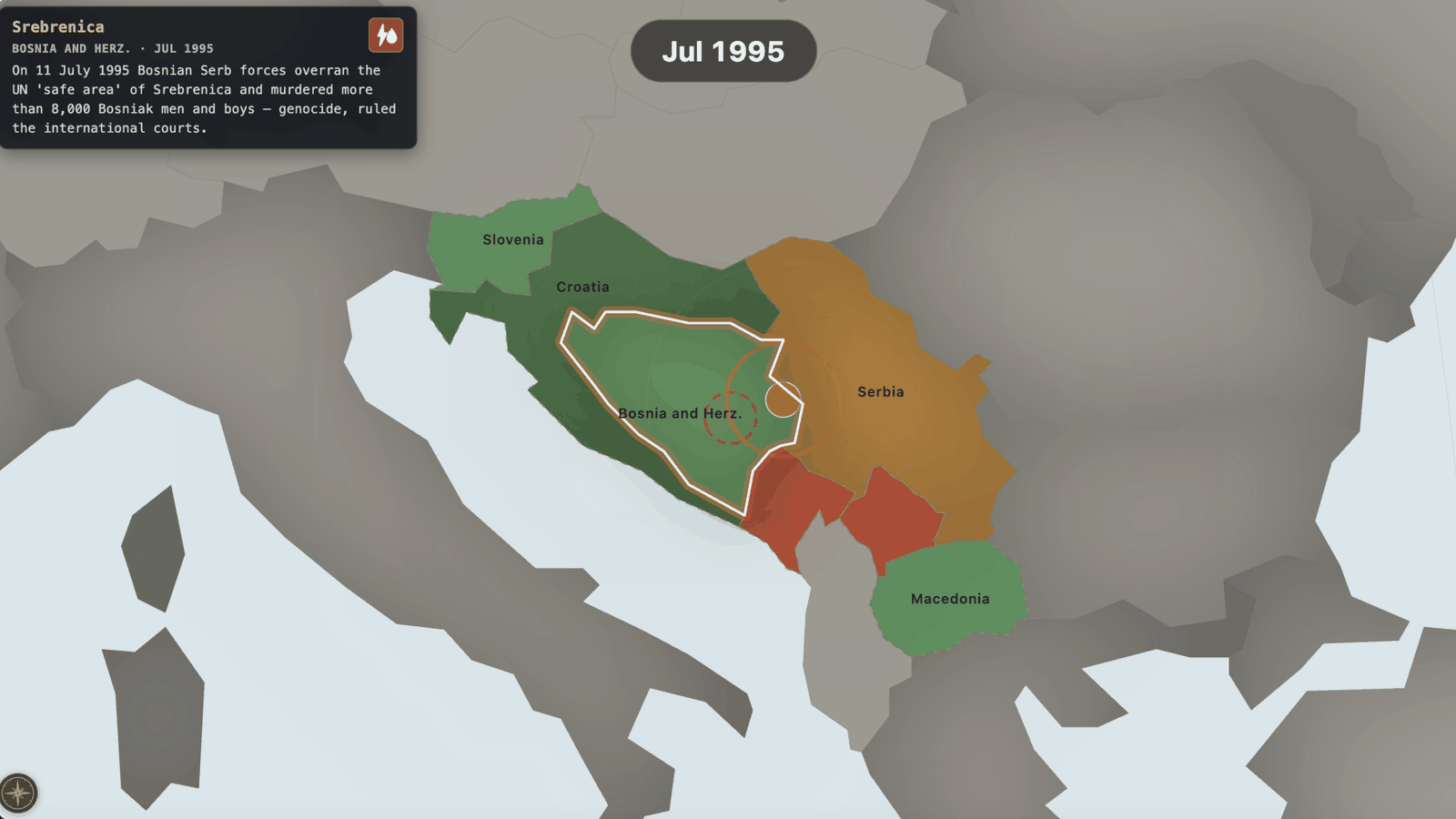
On 11 July 1995, Bosnian Serb forces under Ratko Mladić overran Srebrenica, a UN-declared 'safe area' guarded by a lightly armed Dutch battalion. In the following days they systematically executed more than 8,000 Bosniak men and boys. Both the ICTY and the International Court of Justice ruled the massacre a genocide — the first legally recognized genocide in Europe since World War II. Srebrenica shattered the credibility of the UN mission and pushed NATO toward direct intervention.
Operation Storm
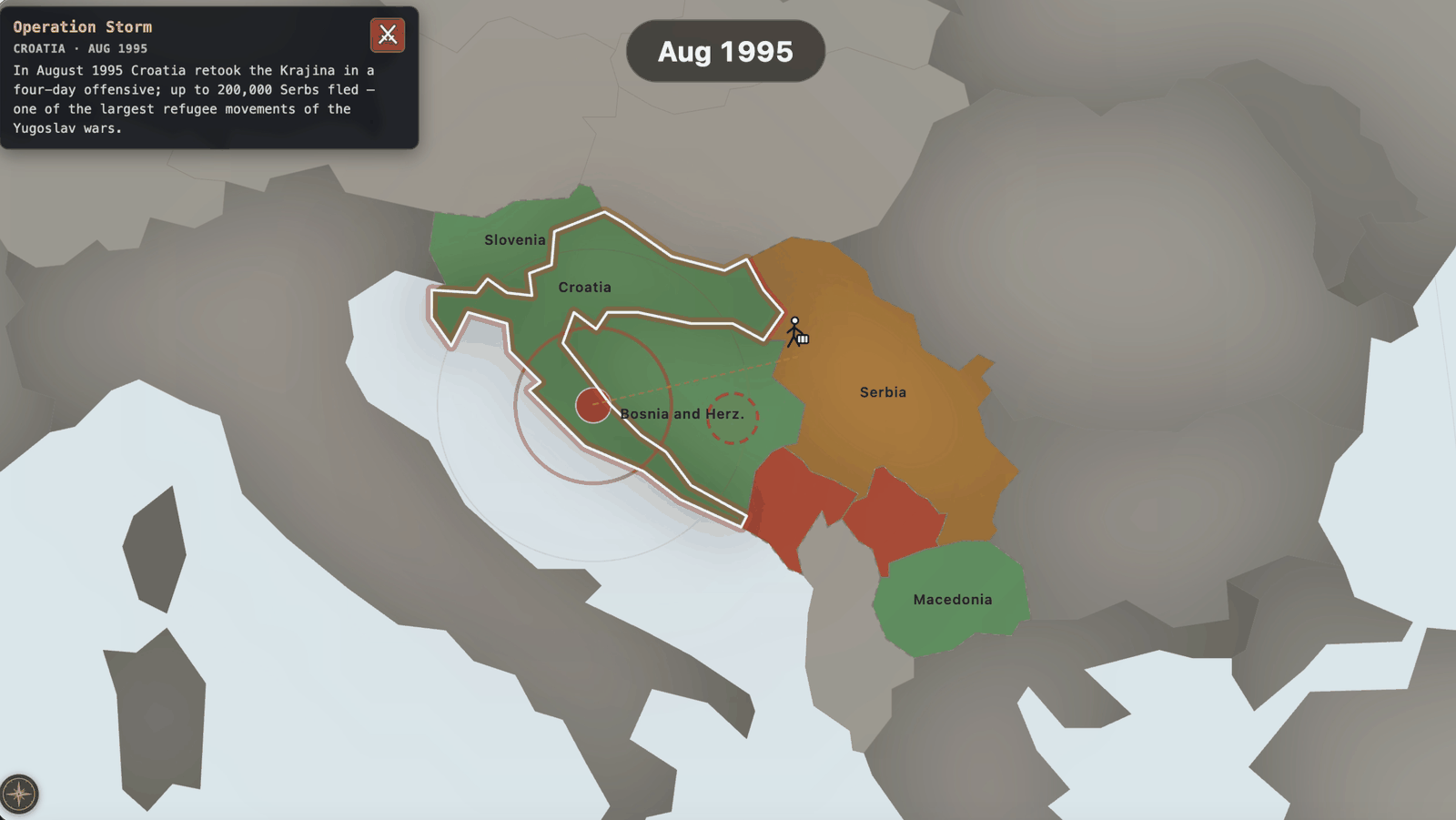
On 4–7 August 1995, the Croatian army retook nearly all of the Serb-held Krajina in Operation Storm, attacking across a 630-kilometre front — the largest land battle fought in Europe between World War II and Russia's 2022 invasion of Ukraine. The self-proclaimed Republic of Serbian Krajina collapsed in four days, and some 150,000–200,000 Serbs fled into Bosnia and Serbia, one of the largest refugee movements of the Yugoslav wars. Together with NATO's bombing of Bosnian Serb positions weeks later, Storm broke the military stalemate and forced all sides to the negotiating table.
The Dayton Agreement
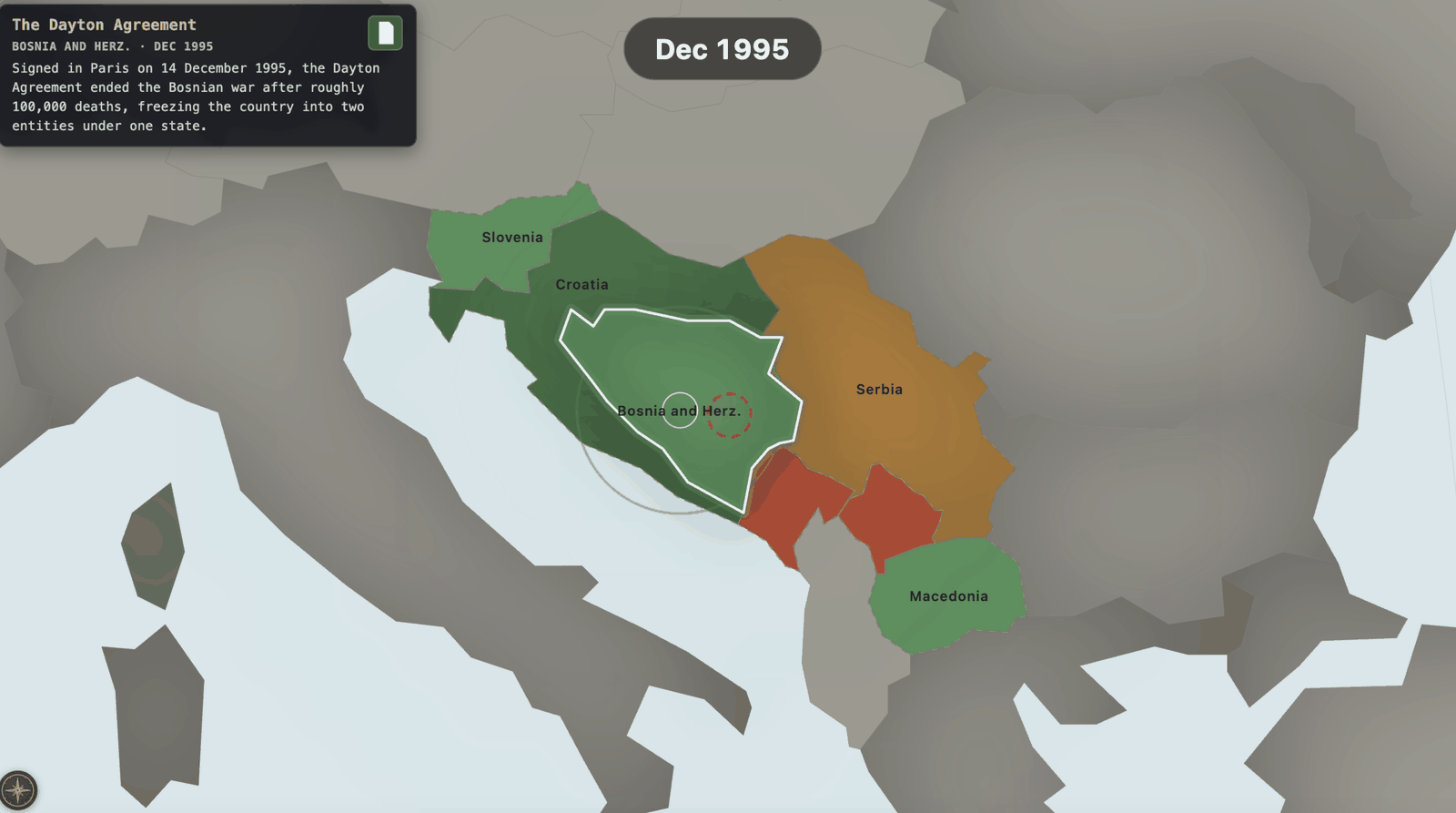
Initialed at Wright-Patterson Air Force Base in Dayton, Ohio, on 21 November 1995 and signed ceremonially in Paris on 14 December by Milošević, Tuđman and Izetbegović, the Dayton Agreement ended the Bosnian war. The conflict had killed roughly 100,000 people and made 2.2 million refugees or displaced — about half the republic's population. Dayton preserved Bosnia as a single state but split it into two entities, the Bosniak-Croat Federation and Republika Srpska — a constitutional freeze that still defines the country.

War Comes to Kosovo
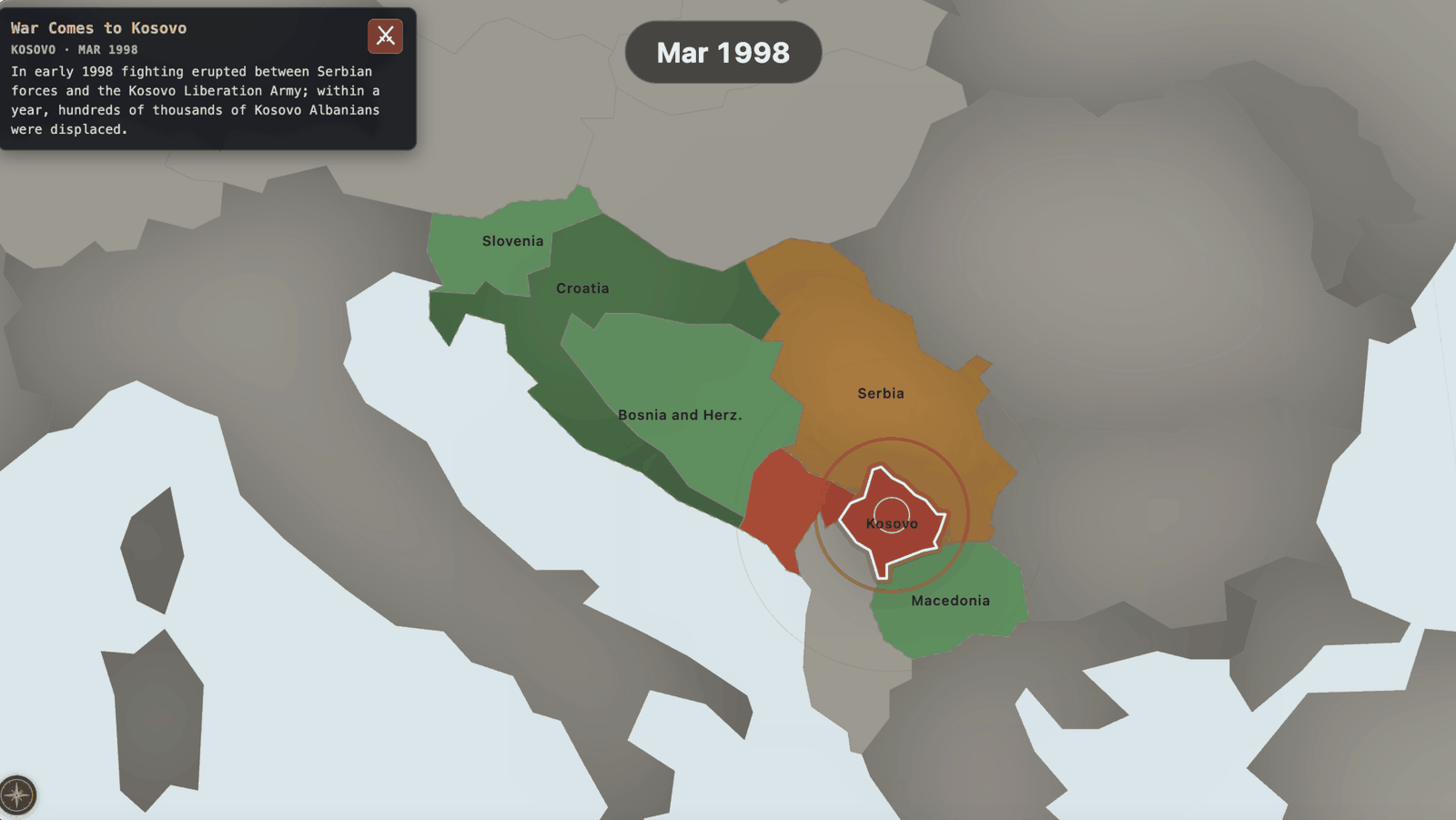
In late February and early March 1998, Serbian police and army units attacked Kosovo Liberation Army strongholds in the Drenica valley, killing dozens including women and children — the point usually taken as the start of the Kosovo War. Kosovo, an autonomous province of Serbia stripped of its self-rule by Milošević in 1989, was 80–90% Albanian. By early 1999, Serbian counter-insurgency campaigns had displaced hundreds of thousands, and Western diplomacy at Rambouillet had failed.
NATO Bombs Yugoslavia
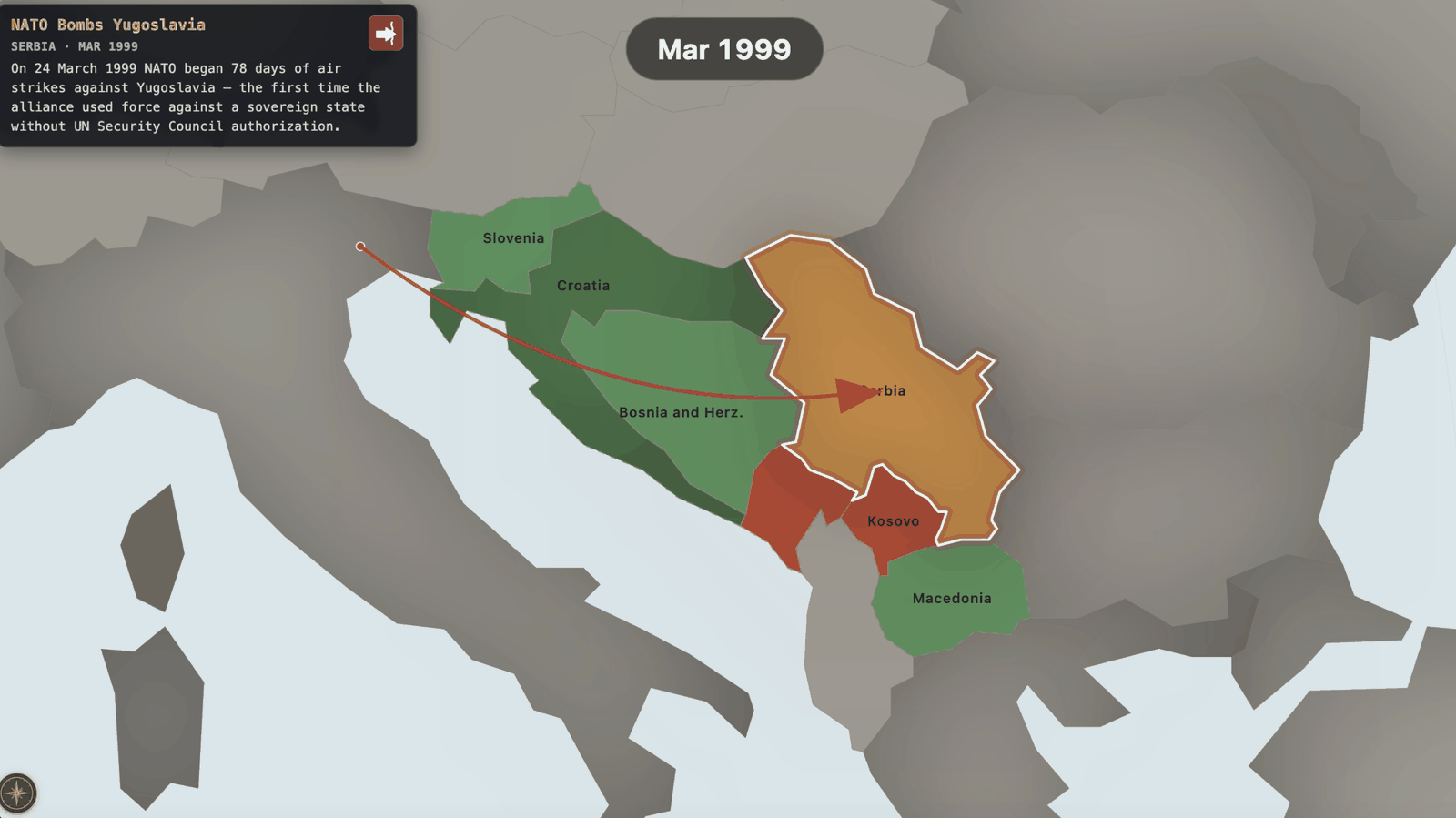
On 24 March 1999, NATO began Operation Allied Force: 78 days of air strikes against the Federal Republic of Yugoslavia to force Milošević to withdraw from Kosovo — the first time the alliance used force without UN Security Council authorization. During the war, Yugoslav forces expelled some 848,000 Kosovo Albanians into neighboring countries; in all, the Kosovo conflict killed 13,535 people. On 9 June 1999 Belgrade signed the Kumanovo agreement, and Yugoslav forces left Kosovo.

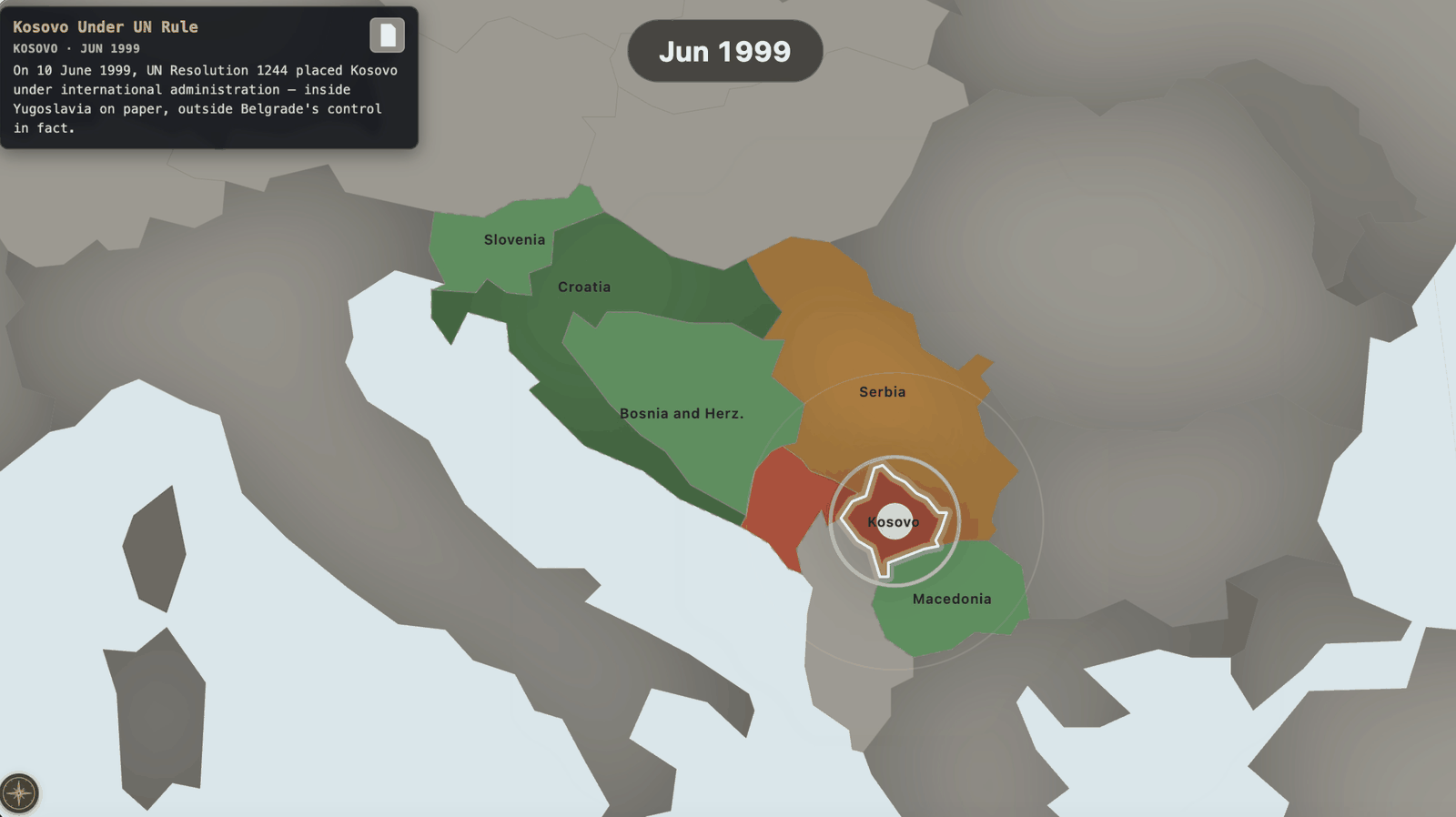
Kosovo Under UN Rule
On 10 June 1999, the UN Security Council adopted Resolution 1244: Yugoslav forces withdrew from Kosovo, NATO peacekeepers (KFOR) moved in, and the province came under UN administration (UNMIK). In the days after the withdrawal, over 164,000 Serbs and 24,000 Roma left Kosovo. On paper Kosovo remained part of Yugoslavia; in practice Belgrade's rule was over. The resolution deliberately left final status unresolved — a limbo that lasted nine years.
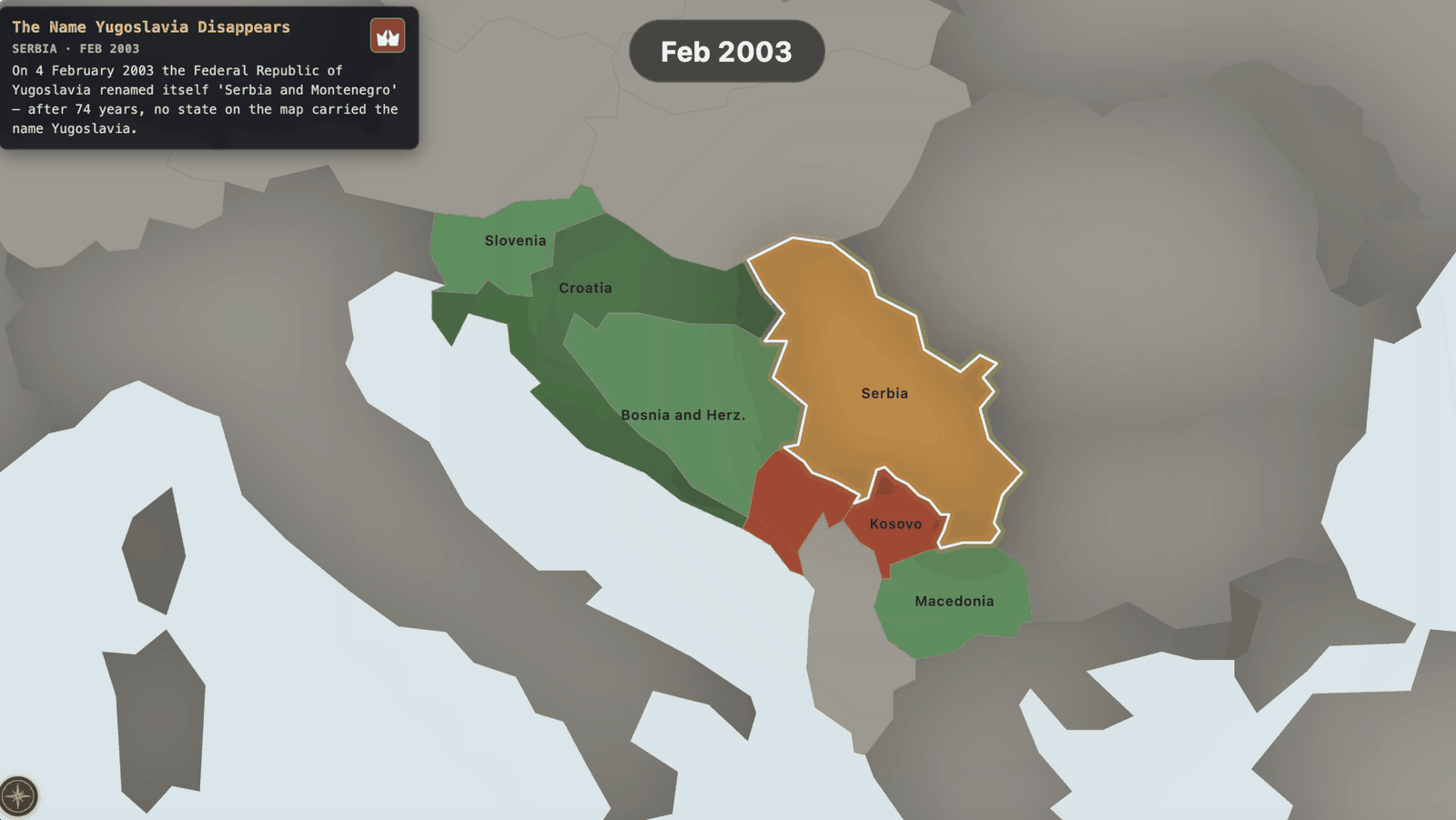
The Name Yugoslavia Disappears
On 4 February 2003, the Federal Republic of Yugoslavia reconstituted itself as the looser State Union of Serbia and Montenegro, brokered by the EU to keep Montenegro from leaving outright. After 74 years — kingdom, socialist federation, rump republic — the name Yugoslavia vanished from the map. The union's Constitutional Charter included a built-in exit: after three years, either member could hold an independence referendum.

Serbia Stands Alone
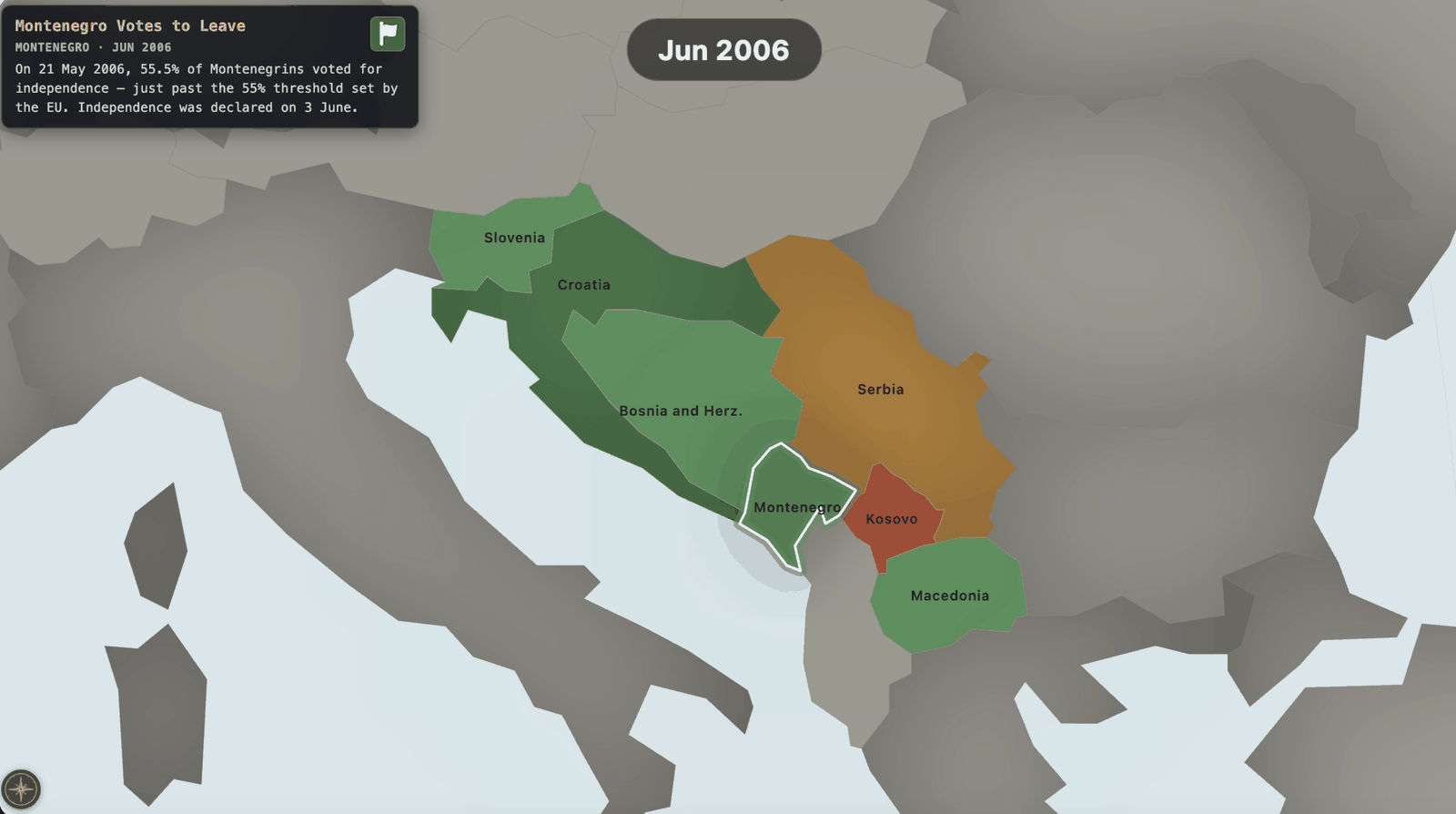
Jun 3, 2006 — Montenegro Votes to Leave: On 21 May 2006 Montenegro held its independence referendum under EU-brokered rules that required 55% approval: 55.5% voted yes, clearing the bar by only about 2,000 votes. Independence was declared on 3 June 2006, dissolving the last remnant of the Yugoslav federation peacefully — by ballot, not by war.
Jun 5, 2006 — Serbia Stands Alone: On 5 June 2006, two days after Montenegro's declaration, Serbia's parliament declared the republic the legal successor of the State Union, as the union's charter prescribed for the remaining member. For the first time since 1918, Serbia was an independent state within its own borders — though one question remained open: Kosovo, still under UN administration.

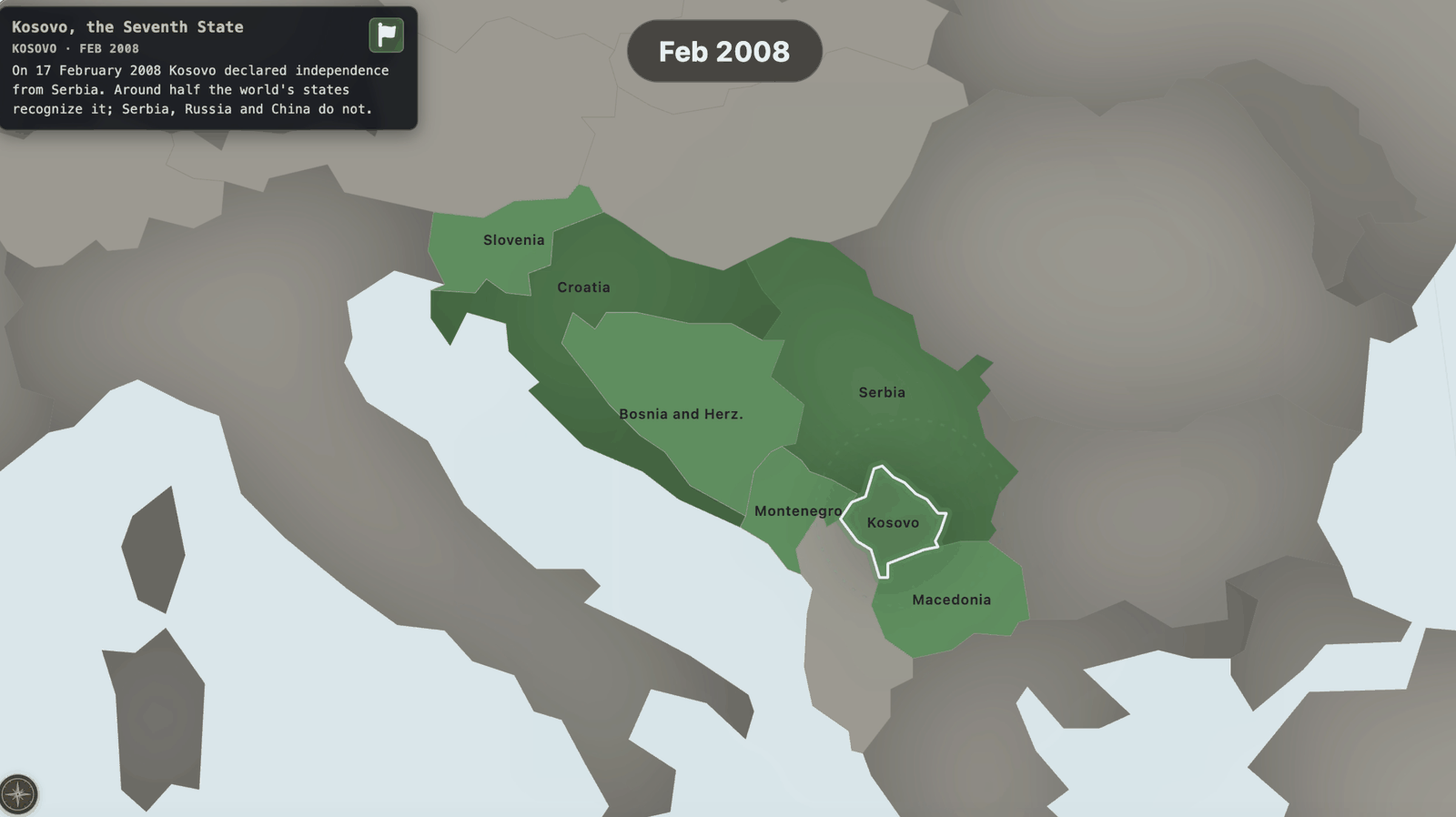
Kosovo, the Seventh State
On 17 February 2008, Kosovo's assembly declared independence from Serbia — the final border change of the Yugoslav breakup. It has been recognized by roughly half the world's states, including the US and most of the EU, but not by Serbia, Russia, China or five EU members. In 2010 the International Court of Justice found the declaration did not violate international law. One country in 1991 had become seven states — or six, depending on whom you ask.
Aftermath: what the breakup left behind
Seven states now stand where one did — or six, depending on whom you ask, since Kosovo's independence is recognized by roughly half the world's governments and rejected by Serbia, Russia, China and five EU members. The comparison with the other great federal collapse of the era is the whole story in one line: the Soviet Union, a state of 290 million spanning eleven time zones, dissolved in twenty-one months with comparatively little bloodshed, while Yugoslavia, a country smaller than Britain, took more than seventeen years to come apart and produced the deadliest conflict in Europe since 1945.
The cost is the reason this map matters. The Yugoslav wars killed between 130,000 and 140,000 people in total, roughly 100,000 of them in Bosnia alone, and displaced some 4.4 million — about 2.4 million refugees plus 2 million driven from their homes inside their own countries. Bosnia accounts for half of that figure on its own: 2.2 million refugees and displaced, close to half the republic's pre-war population. Sarajevo was besieged for 1,425 days, the longest siege of a capital in modern history, and Srebrenica became the first massacre in Europe since the Second World War to be legally ruled a genocide, by both the ICTY and the International Court of Justice.
What the fighting stopped, the treaties froze. Dayton ended the Bosnian war in 1995 by preserving Bosnia as a single state while splitting it into two entities, the Bosniak-Croat Federation and Republika Srpska — an arrangement designed as a ceasefire that has functioned as a constitution ever since, and still defines how the country is governed thirty years later. Kosovo's status was left deliberately unresolved by UN Resolution 1244 in 1999, a limbo that lasted nine years until the 2008 declaration and, in a different form, has never really ended. The map's last line is still contested.
Seen as a sequence, the breakup has a mechanism, and it is not the one usually assumed. No single decision destroyed Yugoslavia. The party died first, at its own congress in January 1990, and once it was gone there was no institution left that belonged to the whole country. Then each stage's unfinished business became the next war's cause: the Serb-held Krajina that Croatia could not recover in 1991 was retaken by force in 1995, sending up to 200,000 people fleeing; the autonomy Milošević stripped from Kosovo in 1989 detonated nine years later. Slovenia, with almost no Serb minority to fight over, was out in ten days. Everywhere the map was mixed, the exit took a decade or more. That correlation — between how cleanly a border could be drawn and how much blood it cost — is the timeline above, drawn on a map.
Sources
- Encyclopaedia Britannica — Yugoslavia (former federated nation)
- Wikipedia — Breakup of Yugoslavia
- Wikipedia — Yugoslav Wars
- Wikipedia — 1991 Croatian independence referendum
- Wikipedia — 14th Congress of the League of Communists of Yugoslavia
- Wikipedia — Ten-Day War
- Wikipedia — Brioni Agreement
- Wikipedia — 1991 Macedonian independence referendum
- Wikipedia — Battle of Vukovar
- Wikipedia — Siege of Sarajevo
- Wikipedia — Serbia and Montenegro
- Wikipedia — Srebrenica massacre
- Wikipedia — Operation Storm
- Wikipedia — Dayton Agreement
- Wikipedia — Kosovo War
- Wikipedia — NATO bombing of Yugoslavia
- Wikipedia — United Nations Security Council Resolution 1244
- Wikipedia — 2006 Montenegrin independence referendum
- Wikipedia — 2008 Kosovo declaration of independence