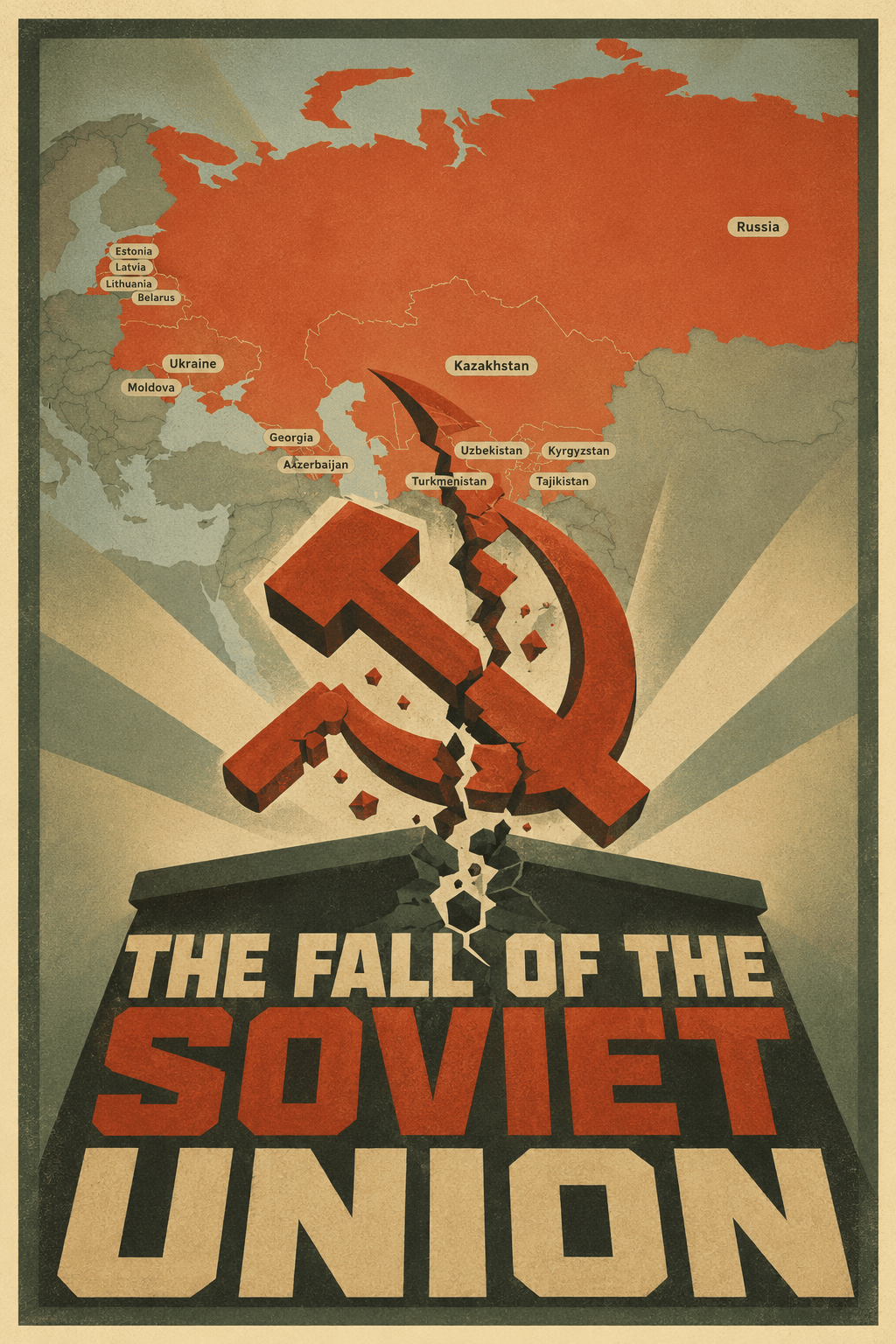
The Fall of the Soviet Union
From the January 1990 crackdown in Baku to Mikhail Gorbachev's resignation on 25 December 1991, these maps trace how the Soviet Union came apart. Fifteen republics declared independence one after another — Lithuania first in March 1990, Kazakhstan last in December 1991 — until the USSR was formally dissolved on 26 December 1991.
Part of the series The Fall of Empires.
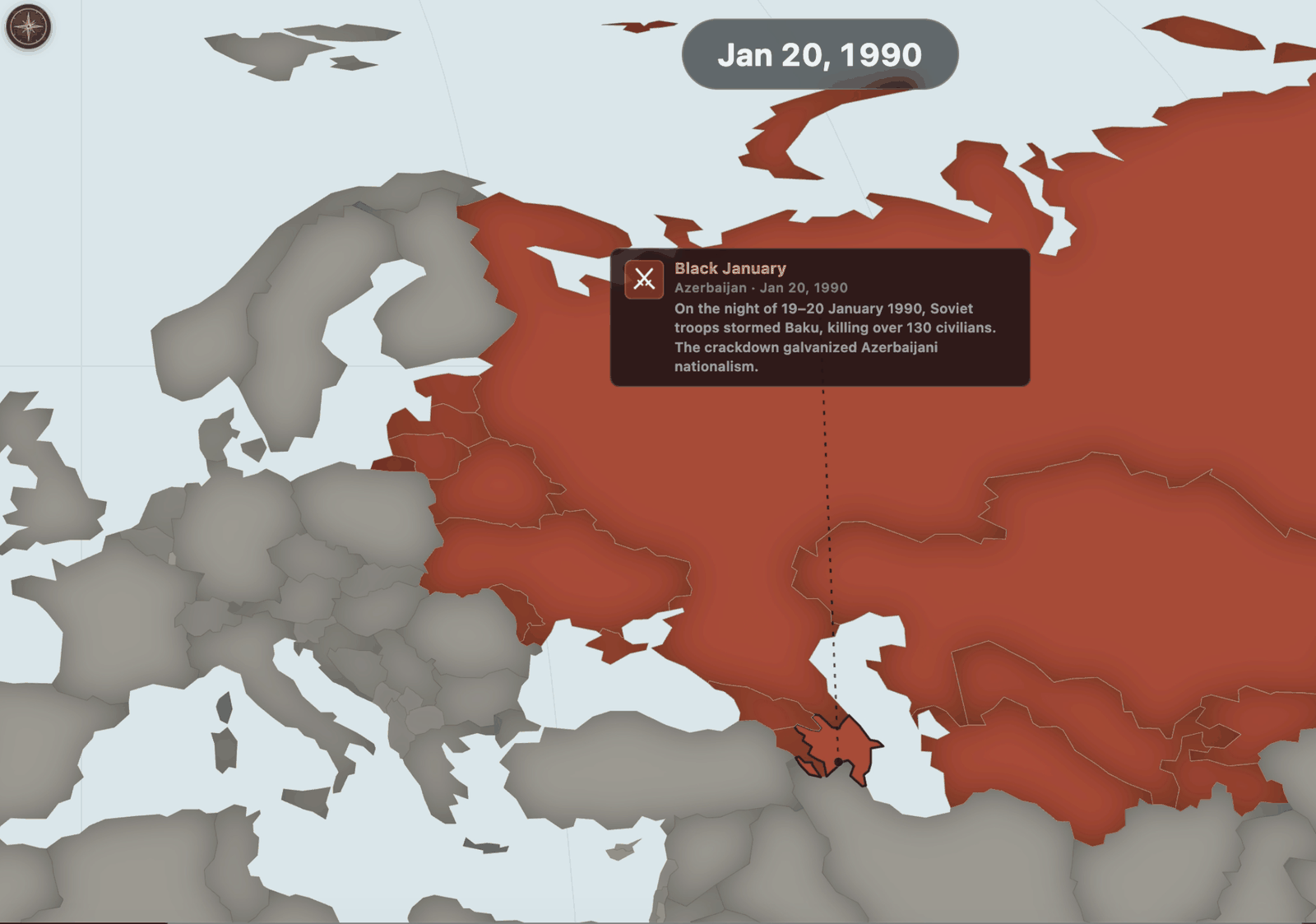
Black January
On the night of 19–20 January 1990, the Soviet army stormed Baku to suppress a mass independence movement and inter-ethnic unrest. The crackdown left 130–170 dead and 700–800 wounded. Known in Azerbaijani as Qara Yanvar, it backfired: rather than crushing the movement, it galvanized Azerbaijani nationalism and accelerated the republic's push for independence.

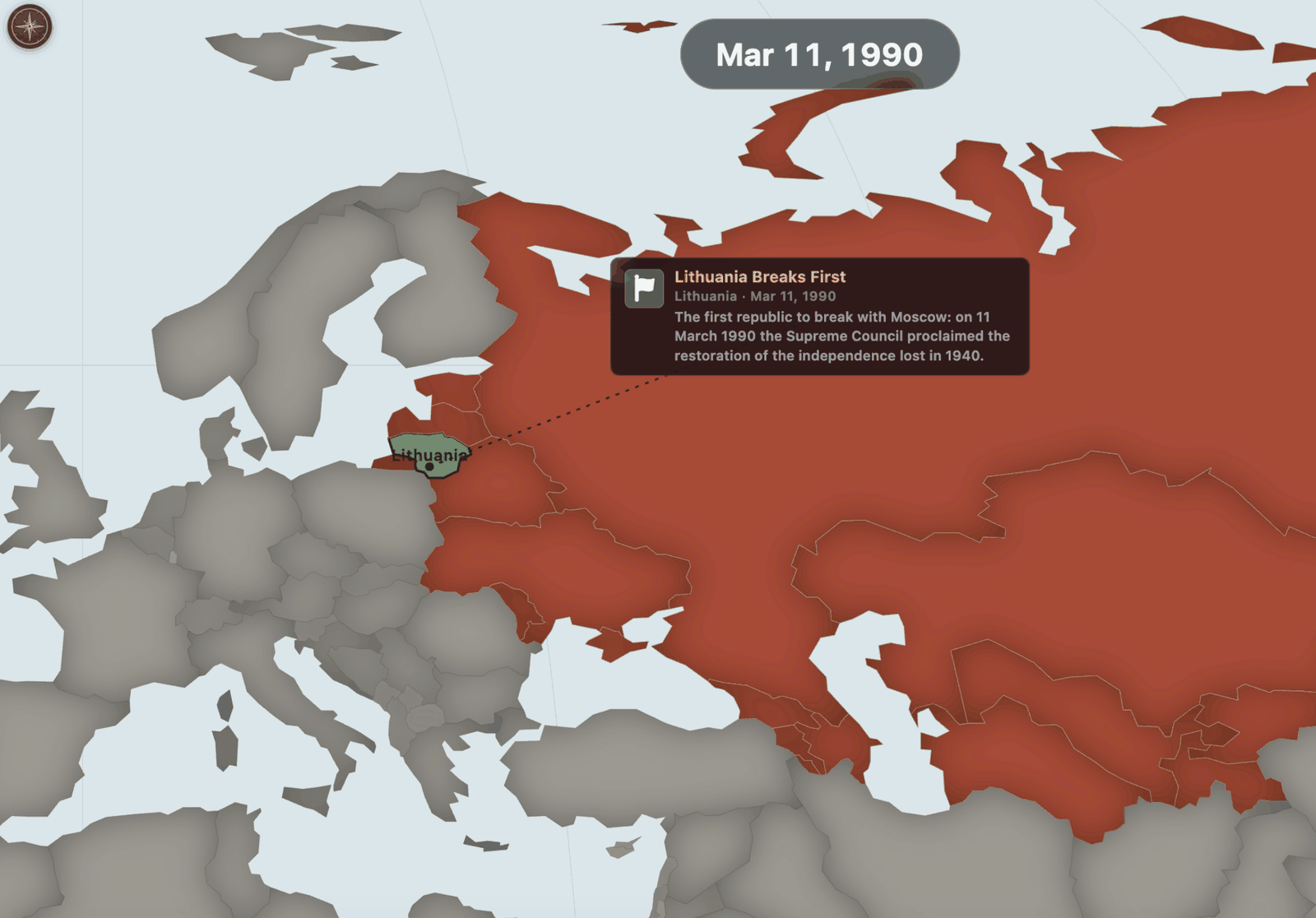
Lithuania Breaks First
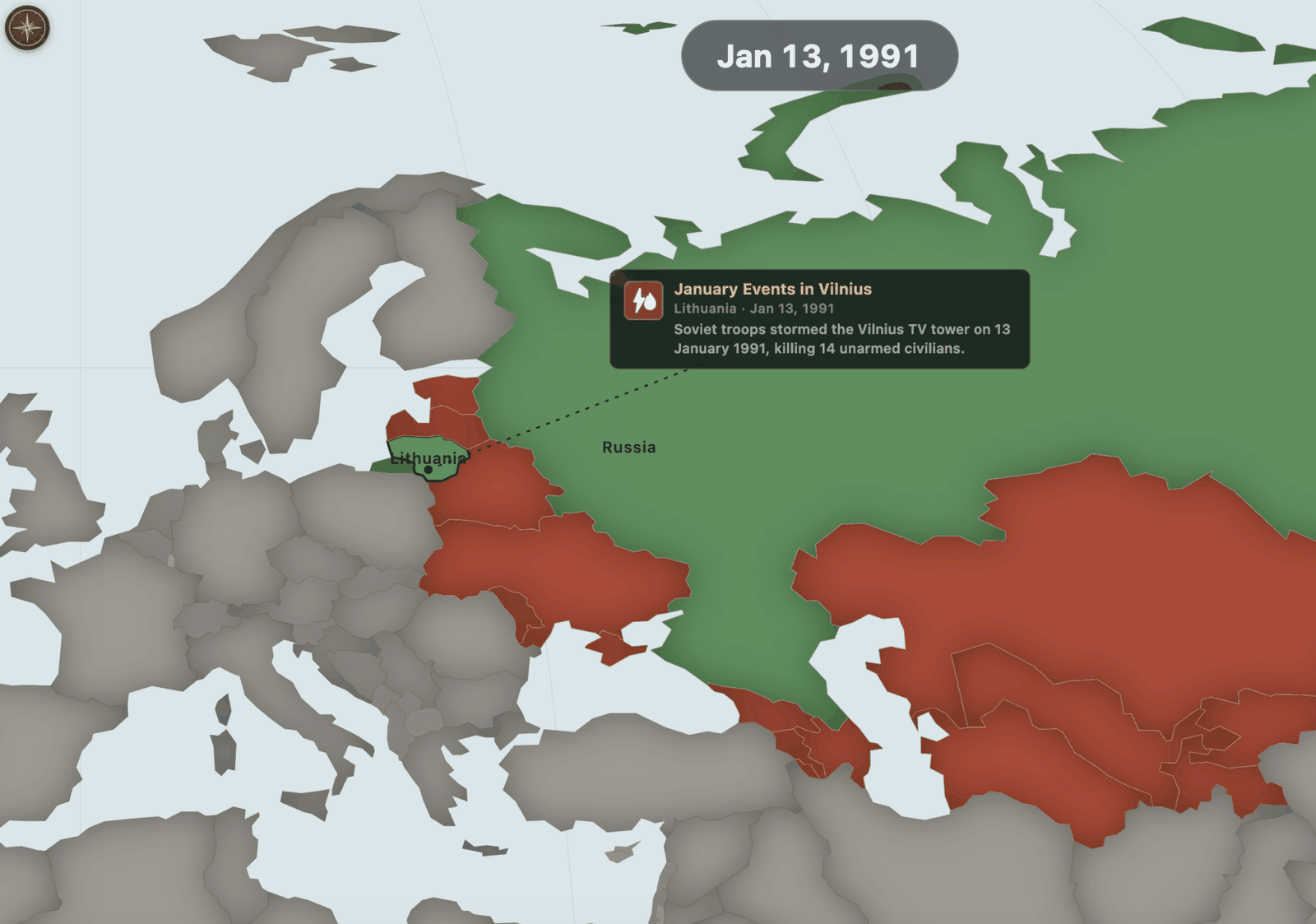
The first republic to break with Moscow: on 11 March 1990 the Supreme Council proclaimed the restoration of the independence lost in 1940. The Kremlin responded with an economic blockade and, in January 1991, with the Vilnius crackdown, which left 14 dead at the television tower.

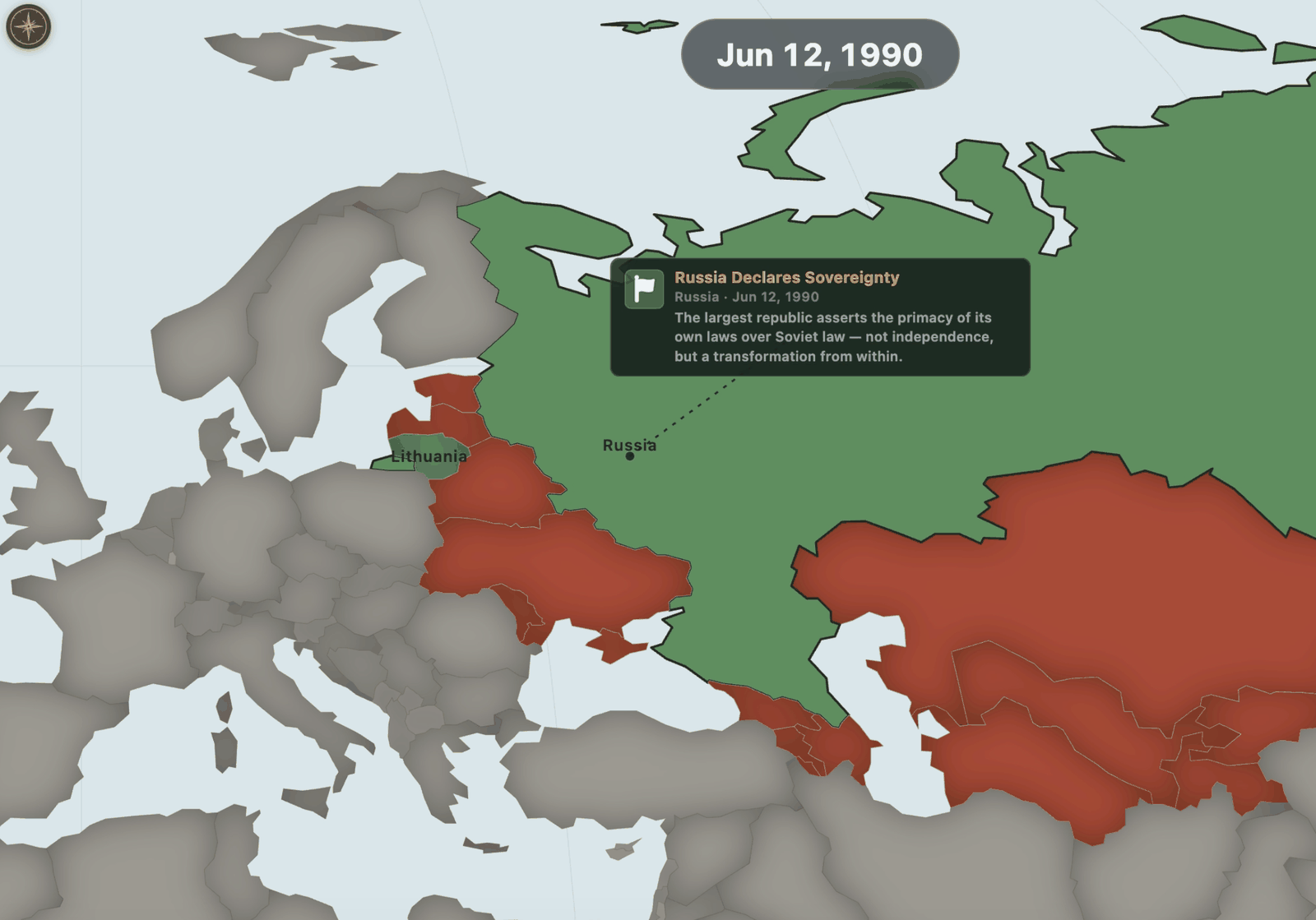
Russia Declares Sovereignty
On 12 June 1990 the Congress of People's Deputies of the Russian Soviet Federative Socialist Republic voted by a large majority to declare state sovereignty. It asserted that Russian law took precedence over Soviet law — a seismic shift, since Russia was the core republic. Unlike the others, Russia did not seek to leave the USSR; it sought to redefine it. June 12 is now celebrated as Russia Day.


January Events in Vilnius
In the early hours of 13 January 1991, Soviet military and KGB units tried to crush Lithuania's independence drive, storming the Vilnius TV tower and radio station. Fourteen unarmed civilians were killed and hundreds injured as crowds tried to shield the buildings. The violence backfired: it hardened Lithuanian resolve, drew international condemnation, and further discredited the Soviet centre months before the August coup.
The Union Referendum
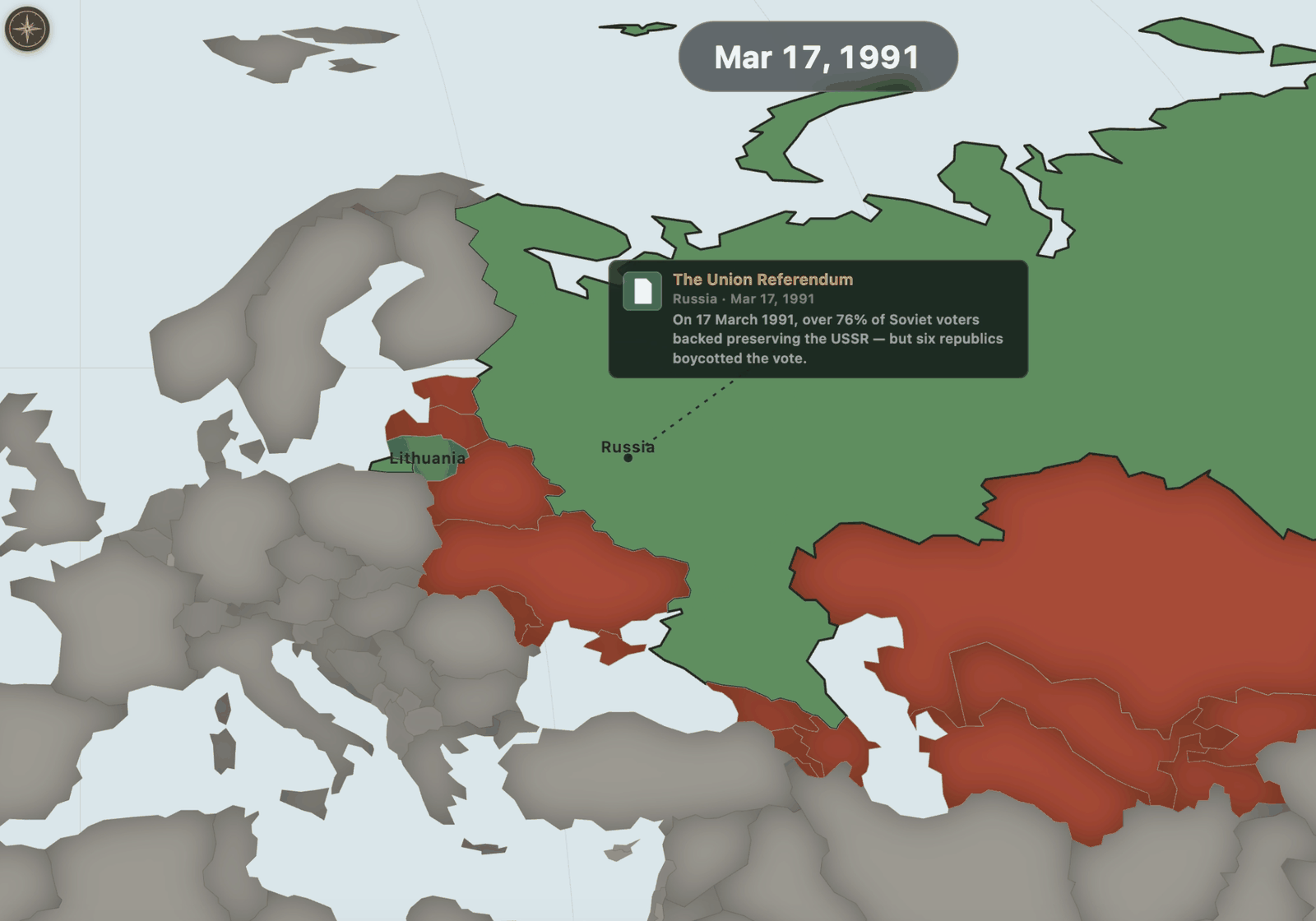
On 17 March 1991 the Soviet Union held its only nationwide referendum, asking whether to preserve the USSR as a renewed federation of sovereign republics. About 77% approved, on a turnout near 80%. But six republics — the three Baltic states, Georgia, Armenia and Moldova — boycotted the vote, having already set course for independence. The result gave Gorbachev a mandate for a new Union Treaty, whose planned August signing triggered the hardliner coup.

Georgia Votes to Leave
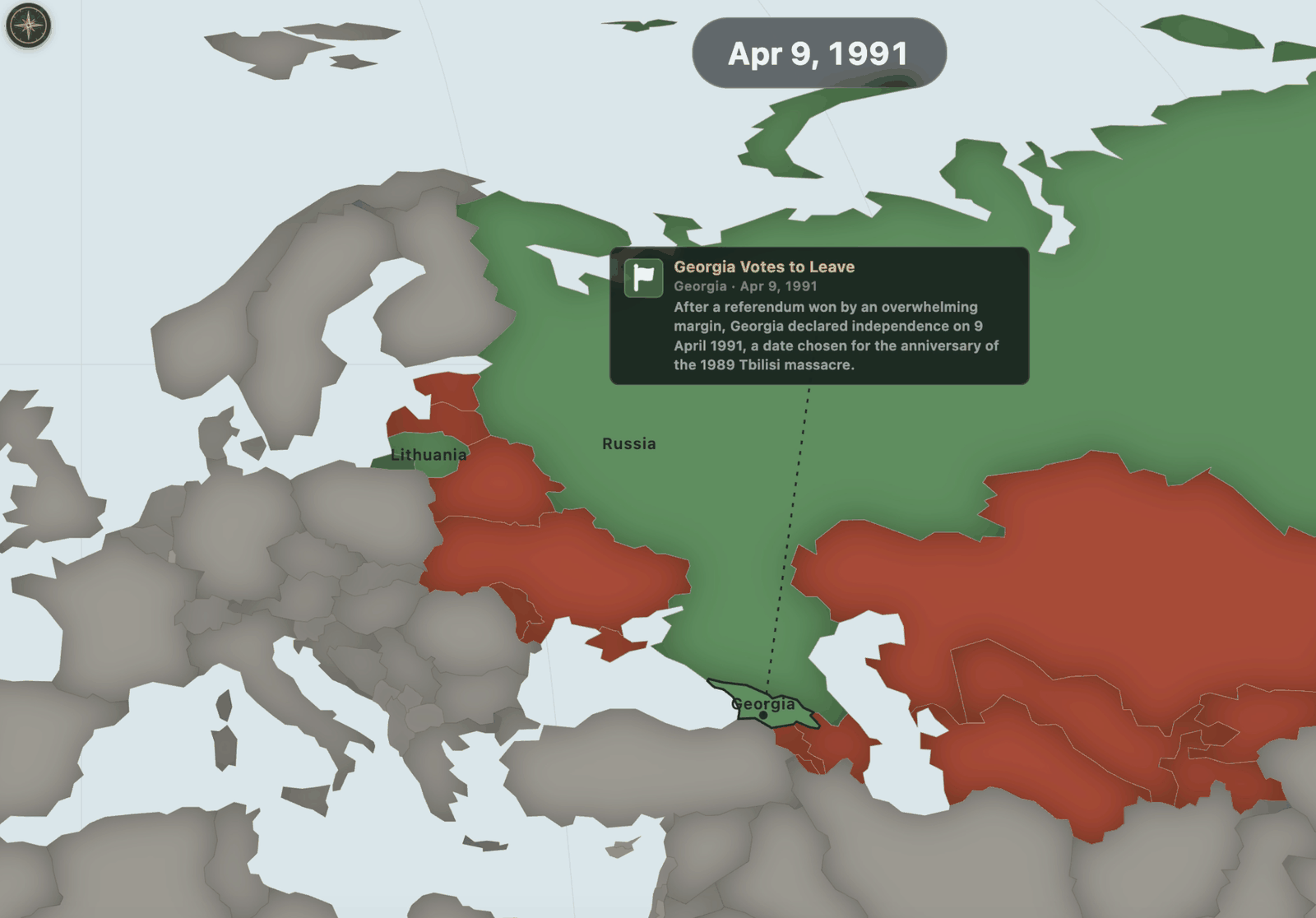
After a referendum won by an overwhelming margin, Georgia declared independence on 9 April 1991, a date chosen for the anniversary of the 1989 Tbilisi massacre. Zviad Gamsakhurdia became its first elected president, before a civil war broke out months later.
August Coup
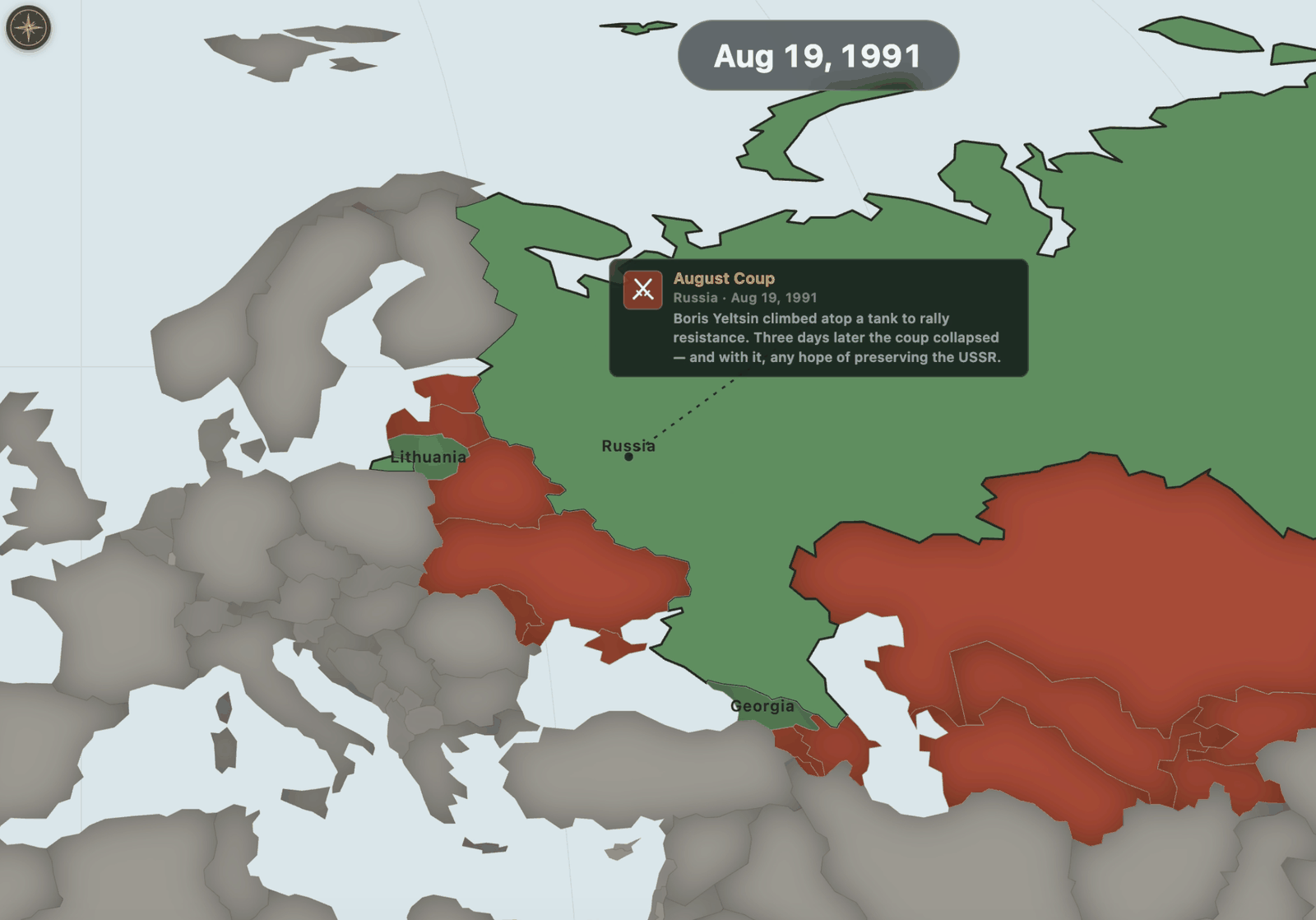
On 19 August 1991, a group of Communist hardliners calling themselves the GKChP declared a state of emergency and sent tanks into Moscow in an attempt to reverse the liberalization of the Soviet Union. Mikhail Gorbachev was placed under house arrest in Crimea. Boris Yeltsin climbed atop a tank outside the Russian White House to rally resistance. Three civilians died in the confrontations. The coup collapsed by 21 August as military units defected and popular opposition grew. Its failure proved fatal to the USSR: within days, republic after republic declared independence, and the Communist Party was suspended.
Moldova Breaks Away
Aug 20, 1991 — Estonia Restores Independence: Estonia restored its independence on 20 August 1991, in the middle of the coup against Gorbachev, seizing the power vacuum in Moscow. It had led the way with the 'Singing Revolution' and the 1989 Baltic Way, the human chain of two million people.
Aug 21, 1991 — Latvia Follows Suit: Latvia proclaimed the full restoration of its independence on 21 August 1991, a day after Estonia, as the coup in Moscow was collapsing. The West quickly recognized all three Baltic republics.
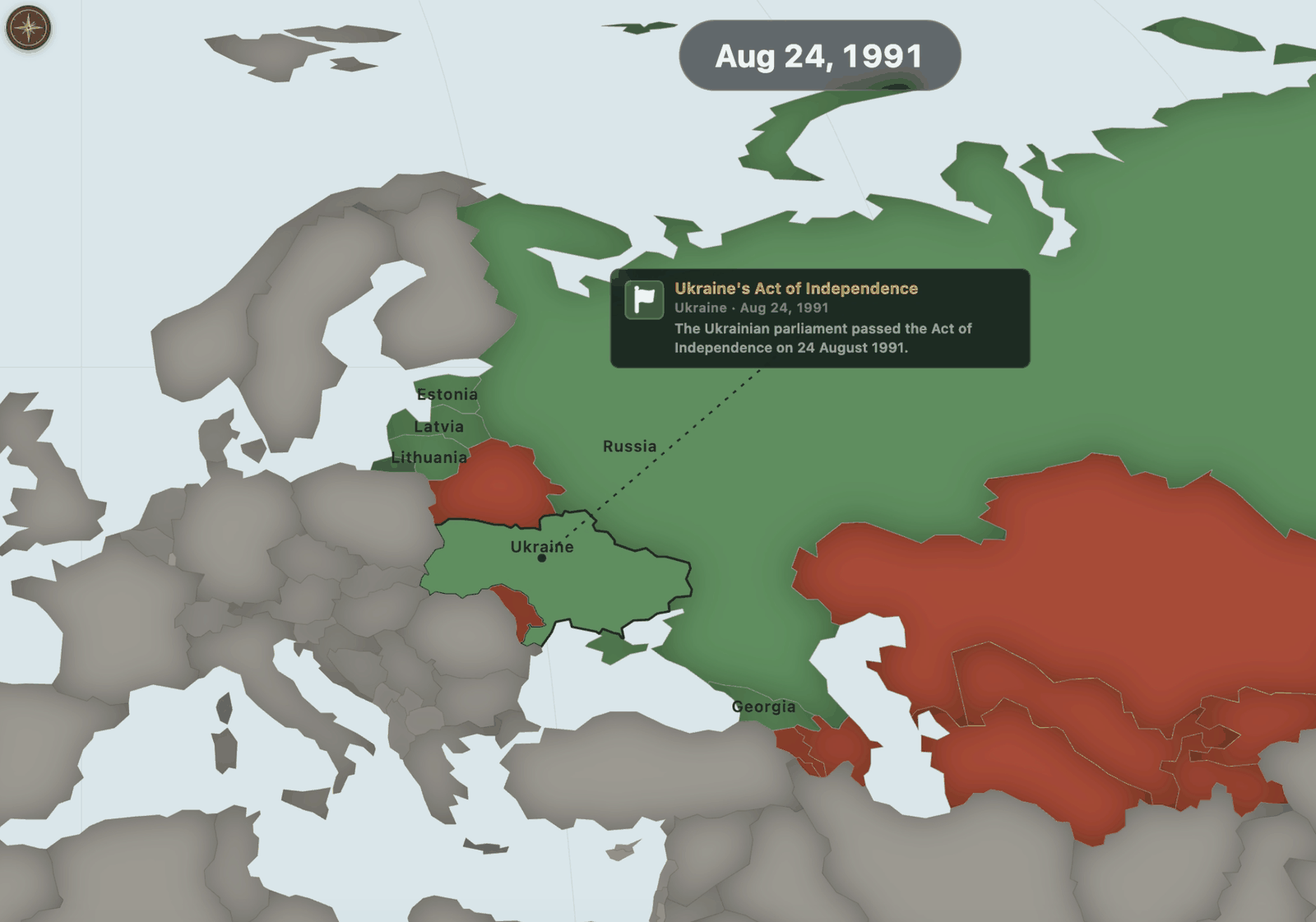
Aug 24, 1991 — Ukraine's Act of Independence: The Ukrainian parliament passed the Act of Independence on 24 August 1991. On 1 December a referendum ratified it with more than 90% of the vote: without Ukraine, the country's second republic, the survival of the USSR became unworkable.
Aug 25, 1991 — Belarus Declares Independence: Belarus proclaimed its independence on 25 August 1991. A few months later, in the Belavezha forest, its leaders would sign the accord with Russia and Ukraine that formally dissolved the Soviet Union and created the CIS.
Aug 27, 1991 — Moldova Breaks Away: Moldova declared independence on 27 August 1991. Tension with the predominantly Russian-speaking eastern strip soon escalated into the armed conflict in Transnistria.

Azerbaijan Leaves amid War
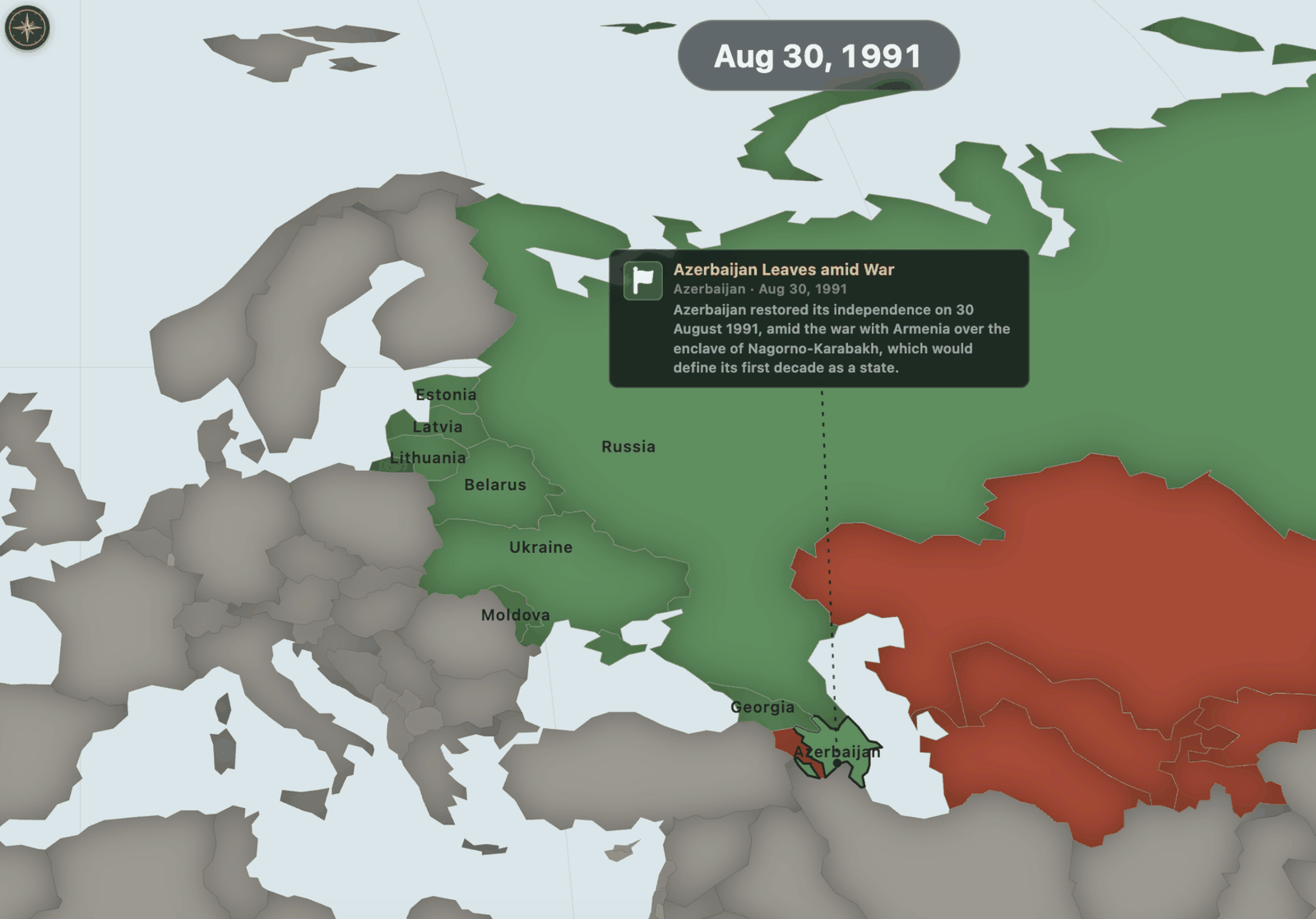
Azerbaijan restored its independence on 30 August 1991, amid the war with Armenia over the enclave of Nagorno-Karabakh, which would define its first decade as a state.
Turkmenistan Votes to Leave
Aug 31, 1991 — Kyrgyzstan Declares Independence: Kyrgyzstan declared independence on 31 August 1991, with reformist Askar Akayev as president, which for a time earned it a reputation as the most open republic in Central Asia.
Sep 1, 1991 — Uzbekistan Proclaims Independence: Uzbekistan, the most populous republic in Central Asia, proclaimed its independence on 1 September 1991. Islam Karimov would rule the new state for 25 years.
Sep 9, 1991 — Tajikistan Declares Independence: Tajikistan declared independence on 9 September 1991. Barely a year later it would fall into a devastating civil war that lasted until 1997.
Sep 21, 1991 — Armenia Votes for Independence: Armenia confirmed its independence by referendum on 21 September 1991, against the backdrop of the Nagorno-Karabakh war with Azerbaijan.
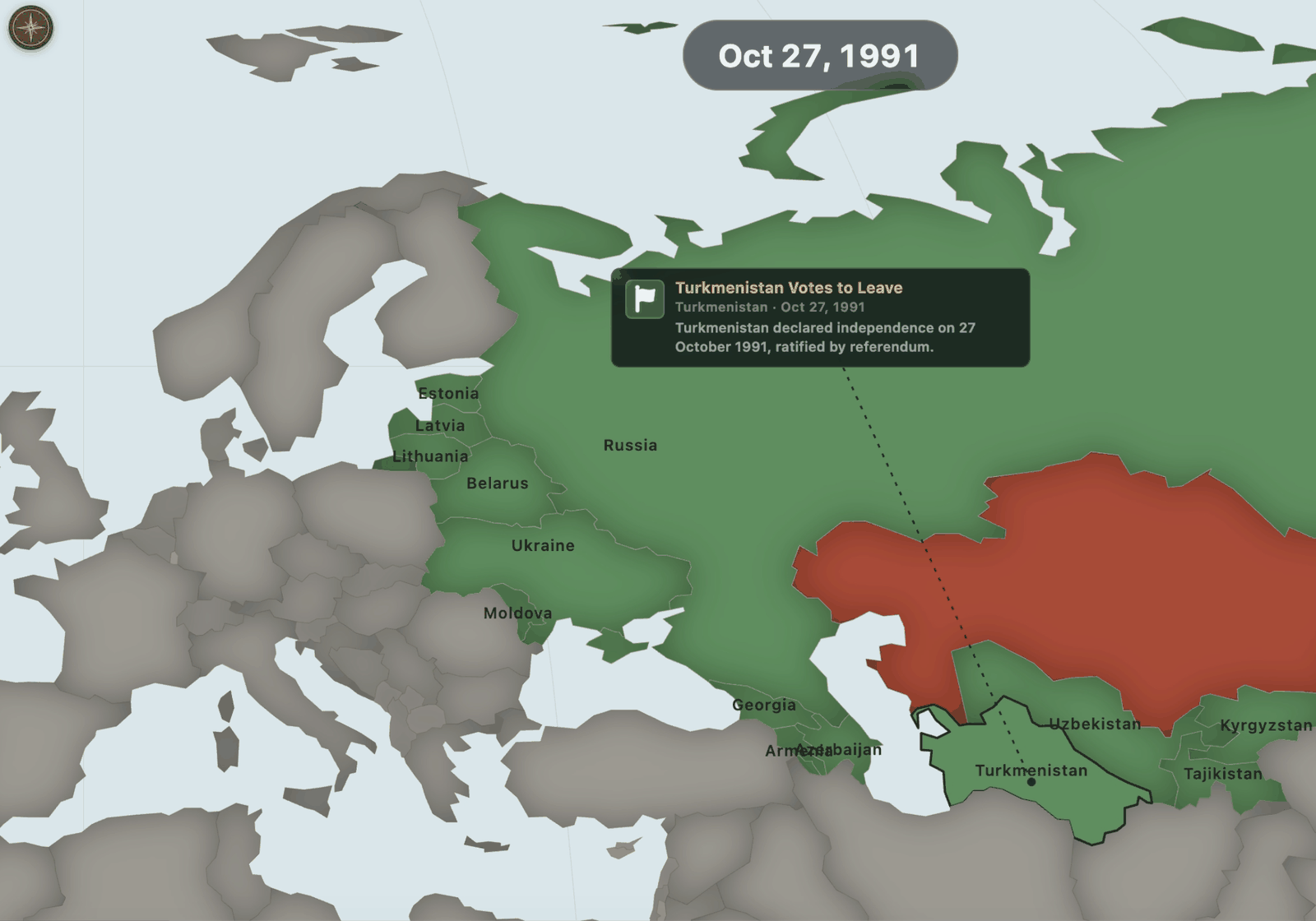
Oct 27, 1991 — Turkmenistan Votes to Leave: Turkmenistan declared independence on 27 October 1991, ratified by referendum. Saparmurat Niyazov — self-styled 'Türkmenbashy' — would establish one of the most closed regimes in the world.

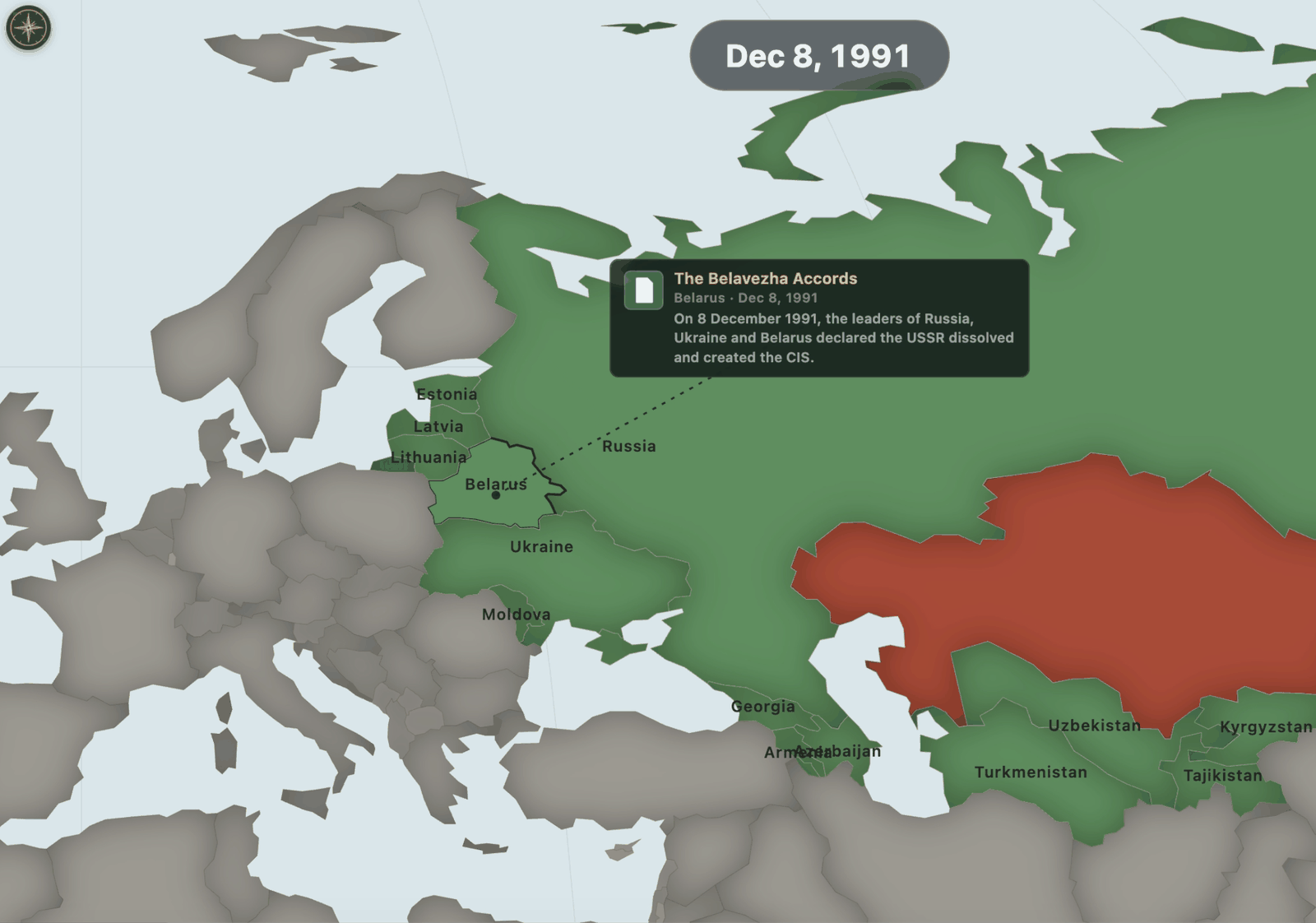
The Belavezha Accords
Meeting in the Belavezha Forest of Belarus on 8 December 1991, the leaders of Russia (Yeltsin), Ukraine (Kravchuk) and Belarus (Shushkevich) — the three Slavic republics that had founded the USSR in 1922 — signed an accord declaring that the Soviet Union 'as a subject of international law and a geopolitical reality' had ceased to exist. In its place they established the Commonwealth of Independent States, sealing the Union's fate over Gorbachev's objections.
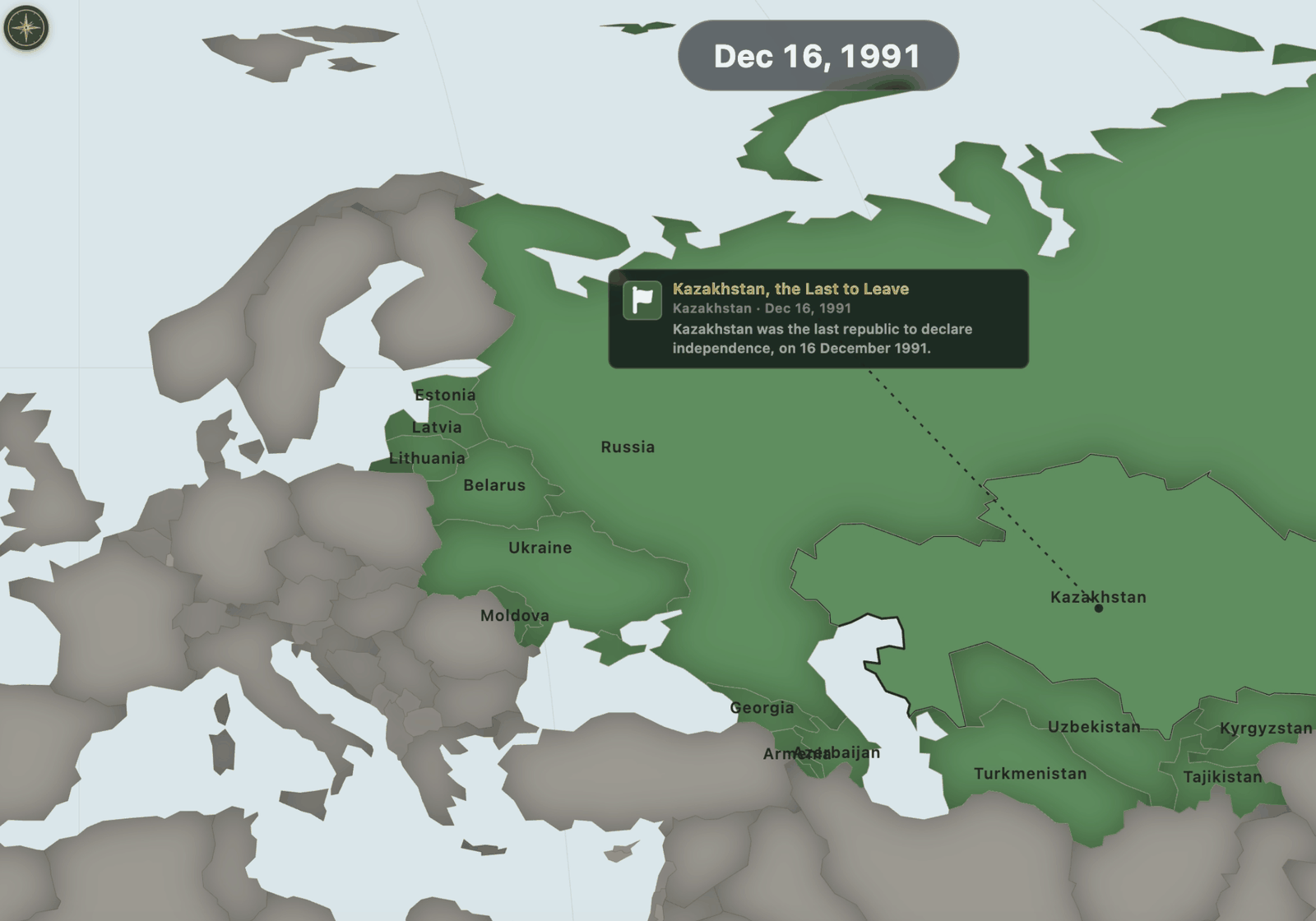
Kazakhstan, the Last to Leave
Kazakhstan was the last republic to declare independence, on 16 December 1991. A large share of the Soviet nuclear arsenal remained on its territory, and was transferred to Russia in the following years.

End of the USSR
Dec 21, 1991 — The Alma-Ata Protocol: On 21 December 1991, eleven of the twelve remaining Soviet republics met in Alma-Ata (Almaty), Kazakhstan, and signed protocols formally joining the Commonwealth of Independent States and confirming the dissolution of the Soviet Union. Georgia, then in civil war, was the lone holdout. The declaration extended the Belavezha Accords beyond the three Slavic republics to Central Asia and the Caucasus, and agreed that Russia would assume the USSR's UN seat.
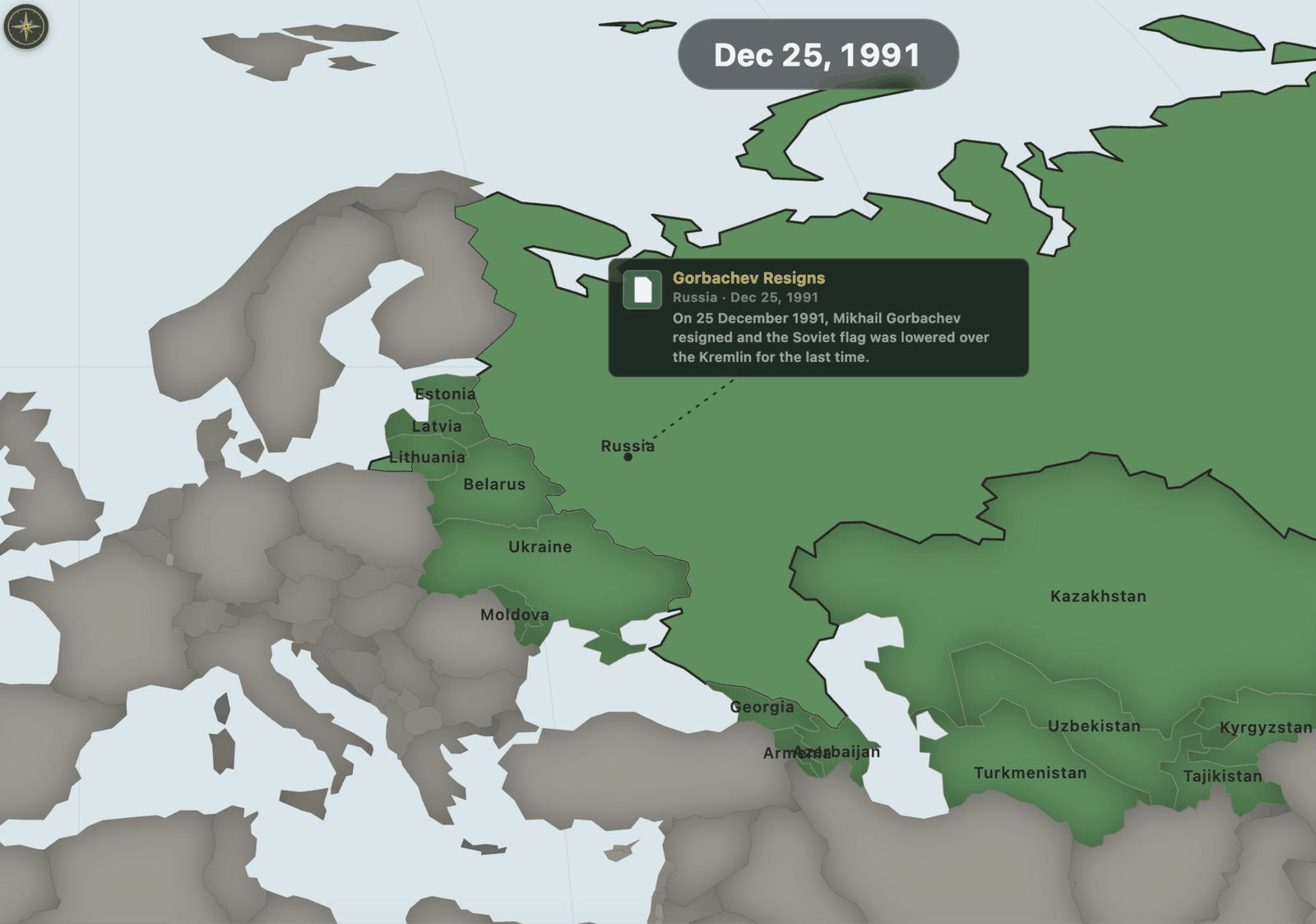
Dec 25, 1991 — Gorbachev Resigns: On the evening of 25 December 1991, Mikhail Gorbachev announced his resignation as President of the Soviet Union in a televised address, handing the nuclear codes to Boris Yeltsin. That night the red Soviet flag was lowered over the Kremlin and replaced by the Russian tricolour. The following day the Supreme Soviet formally voted the USSR out of existence.
Dec 26, 1991 — End of the USSR: On 25 December 1991 Mikhail Gorbachev resigned and the red flag was lowered over the Kremlin for the last time. The next day, 26 December, the Supreme Soviet of the Soviet Union passed its final declaration, formally dissolving the USSR. Russia inherited the permanent UN Security Council seat and the nuclear arsenal.
Aftermath: what the collapse changed
Fifteen new states appeared on the map where one had been, in the largest dissolution of a state in the twentieth century — achieved, for its scale, with remarkably little bloodshed, though not none: Baku and Vilnius are in the timeline above. The bipolar order that had organized world politics since 1945 ended not with a war but with a chain of declarations — twenty-one months from Lithuania's break in March 1990 to the formal dissolution on 26 December 1991.
Russia assumed the role of successor state, inheriting the Soviet seat on the UN Security Council and, over the following years, the consolidated nuclear arsenal — roughly 30,000 warheads that in December 1991 sat scattered across four republics. That handover is a story of its own, told in our companion map on the Soviet nuclear inheritance.
The internal administrative lines of the USSR became international borders overnight, freezing into place boundaries that had been drawn for very different purposes. Many of the region's later fault lines — from the Baltic to the Caucasus to Crimea — run along those lines, which is why this map remains a reference point for reading the region's geopolitics today.
Seen as a sequence, the collapse also left a method: no single declaration ended the union. It was the accumulation — a spark in the Baltics, a failed coup in Moscow, a cascade of exits in ten days — that made the outcome irreversible. The timeline above is that mechanism, drawn on a map.